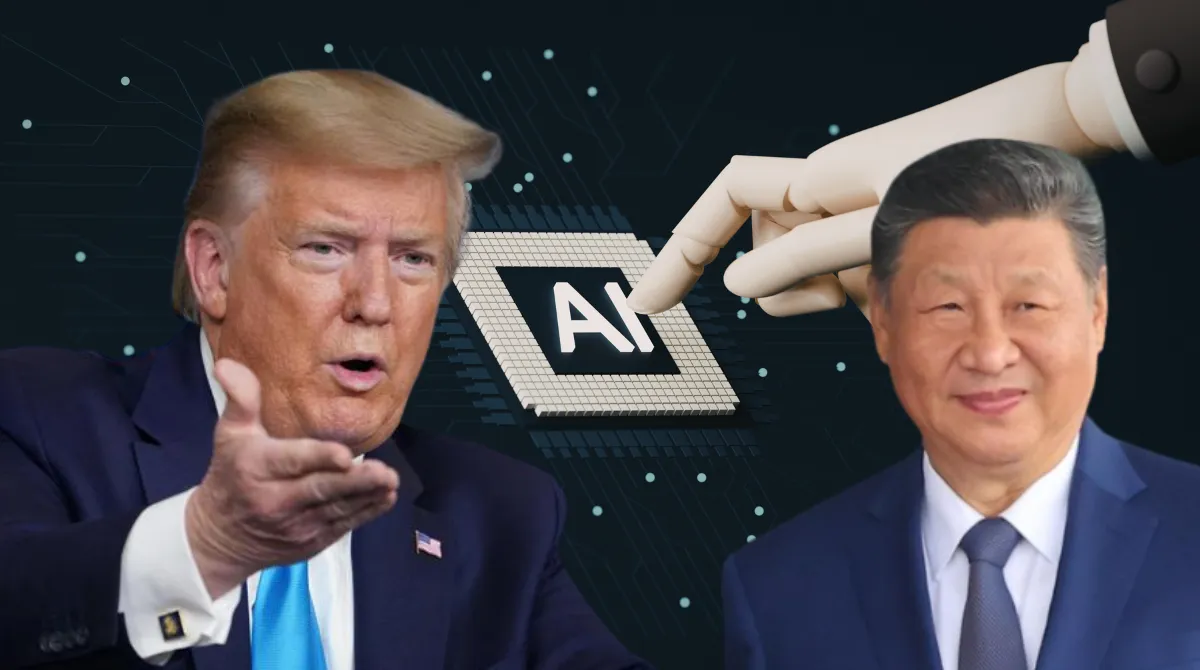
The White House just accused China of stealing American artificial intelligence at mass scale. Congress is alarmed. Silicon Valley is furious. And somewhere in all of that outrage, nobody is asking the obvious question: who’s actually paying for this arms race?
Not the CEOs. Not the shareholders. Not the policymakers drafting memos in Washington.
The people paying are the ones getting laid off at Meta, Amazon, Google, and every other U.S. tech company that has decided the only way to win a war over AI supremacy is to cut human headcount and pour the savings into compute, models, and infrastructure.
The geopolitical story and the labor story are the same story. It’s just that only one of them makes the front page.
What the White House Memo Actually Says
A memo circulated by the White House this week, first reported by BBC News, claims that Chinese firms have engaged in systematic, large-scale theft of American AI technology — including model weights, training data, proprietary architectures, and research that U.S. companies have spent billions developing.
The memo frames this as a national security crisis. Chinese state-linked actors, it argues, are not just copying American AI — they are using stolen intellectual property to leapfrog years of development, potentially allowing China to field military, surveillance, and economic AI systems that match or exceed U.S. capabilities without bearing the R&D costs.
The administration has used this framing to justify continued export controls on advanced semiconductors, restrictions on AI research collaboration with Chinese institutions, and increased pressure on U.S. tech companies to harden their internal security postures.
What the memo does not address is what all of this costs — and who bears that cost.
The Arms Race Nobody Voted For
Here is the economic logic that connects a White House memo about Chinese espionage to a layoff notice landing in an American engineer’s inbox.
When the U.S. government signals that AI supremacy is a matter of national survival, it creates an environment where every major tech company feels existential pressure to accelerate its AI development. Not just to stay competitive commercially — but to stay relevant geopolitically, to maintain government contracts, to avoid being labeled a security risk, and to attract the talent and capital that flows toward perceived winners in strategic industries.
Accelerating AI development costs money. Enormous amounts of it. Meta has committed over $65 billion in AI capital expenditure for 2026 alone. Google’s parent Alphabet is spending comparably. Amazon’s AWS AI infrastructure buildout is projected to exceed $100 billion over the next three years, according to Bloomberg.
That money has to come from somewhere. And in the financial architecture of large public companies, the fastest, cleanest way to redirect capital toward infrastructure is to cut the payroll that was funding everything else.
This is not a conspiracy. It is accounting. And the people on the wrong side of that accounting equation are the ones who built these companies in the first place.
The Direct Line From Geopolitics to Your Layoff
Consider the sequence of events that connects a classified White House memo to a termination email:
Washington declares AI a strategic priority and signals that falling behind China is unacceptable. Investors reprice tech stocks based on AI exposure — companies with aggressive AI buildouts get premium valuations, those without get punished. Boards pressure CEOs to demonstrate AI commitment through capital allocation. CFOs identify payroll as the largest discretionary cost line. HR announces “strategic restructuring to invest in the future.” You get 60 days notice and a severance package.
The causal chain is real and it is accelerating. Meta cut 1,500 jobs from Reality Labs in January 2026 and simultaneously announced its largest-ever AI infrastructure investment. Amazon is targeting up to 30,000 corporate roles while building data centers at a pace that has no historical precedent. Google has conducted multiple rounds of targeted cuts while its DeepMind division expands headcount.
In each case, the narrative offered to investors and the public is some variation of “we are becoming a leaner, more AI-focused organization.” What that phrase means in practice is: we are replacing expensive humans with cheaper compute, and the geopolitical urgency created by competition with China gives us political cover to do it faster than we otherwise would.
| Company | 2026 Jobs Cut | 2026 AI Capex | Official Reason | Actual Driver |
|---|---|---|---|---|
| Meta | ~3,600+ (ongoing) | $65B+ | “AI realignment” | Payroll → compute reallocation |
| Amazon | Up to 30,000 | $100B+ (3yr) | “Streamlining operations” | Corporate layers → AWS AI infra |
| Google/Alphabet | Multiple rounds | $75B+ | “Efficiency and focus” | Search revenue pressure + AI race |
| Microsoft | ~6,000 (Jan 2026) | $80B+ | “Organizational changes” | OpenAI integration, Copilot scaling |
| Intel | ~15,000 (ongoing) | Varies | “Manufacturing pivot” | Lost AI chip market share to Nvidia |
What China’s AI Strategy Actually Looks Like
To understand why the White House memo landed with such force, it helps to understand what Chinese AI development actually looks like from the inside of the U.S. intelligence community.
China’s approach to AI is not purely imitative. But it has benefited enormously from access to American research — through academic collaboration, corporate partnerships that have since been restricted, talent pipelines from U.S. universities, and, according to the White House memo, direct theft of proprietary systems.
The emergence of DeepSeek in early 2025 was the moment that crystallized the threat for many in Washington. DeepSeek, a Chinese AI lab, released a model that matched or exceeded the performance of leading American systems at a fraction of the reported training cost. The implication — that China had found ways to work around the semiconductor export controls that were supposed to slow its AI development — sent shockwaves through the U.S. policy and investment communities.
The response has been a further tightening of export controls, increased counterintelligence focus on AI-related corporate espionage, and — critically — a political environment in which any U.S. tech company that is not visibly racing to stay ahead of China risks being seen as a national security liability.
That political pressure translates directly into boardroom urgency. And boardroom urgency, in 2026, translates directly into layoffs.
The Workers Caught in the Middle
None of this is abstract for the people losing their jobs. The engineers, program managers, content moderators, and operations staff being cut from U.S. tech companies did not choose to be pawns in a geopolitical competition. They built careers at companies they believed in, often relocating, taking pay cuts to get in the door, spending years developing institutional knowledge that is now being declared redundant.
The cruelest part of the current wave of AI-driven layoffs is that many of the people being cut are being replaced not by Chinese competitors, but by the AI systems their own companies built — systems that exist, in part, because of the work those employees did.
The debate about whether AI truly replaces jobs or simply transforms them continues among economists. But that debate is of limited comfort to someone holding a termination letter from a company that just announced a $65 billion AI investment in the same quarter it eliminated their position.
What these workers need is not a geopolitical briefing. They need practical information about what comes next — severance negotiation, unemployment eligibility, skills that remain valuable in an AI-saturated labor market, and an honest assessment of which industries are still hiring humans in meaningful numbers.
Which Jobs Are Still Safe and Which Aren’t
The AI arms race is not eliminating all work equally. The pattern that emerges from 2025-2026 layoff data is consistent: roles that involve repetitive cognitive tasks at scale are most exposed. Roles that require physical presence, complex judgment under uncertainty, or genuine human relationship management are least exposed — at least for now.
| Role Type | AI Exposure | 2026 Outlook | What Protects You |
|---|---|---|---|
| Mid-level software engineer | 🔴 High | Contracting | Systems architecture, AI tooling skills |
| Content moderation / ops | 🔴 High | Contracting fast | Minimal — category under severe pressure |
| Data analyst (junior/mid) | 🔴 High | Contracting | Domain expertise + AI tool proficiency |
| AI/ML engineer | 🟢 Low | Growing fast | Building the systems doing the replacing |
| Cybersecurity specialist | 🟢 Low | Growing | AI theft threat creates demand |
| Skilled trades (electrician, HVAC) | 🟢 Low | Strong | Physical presence, cannot be offshored or automated cheaply |
| Healthcare (clinical) | 🟡 Medium | Stable | Regulatory requirements, human judgment essential |
| Program manager / PMO | 🟠 Medium-high | Shrinking | Executive-level only; mid-level at risk |
The irony that cybersecurity specialists — the people tasked with stopping exactly the kind of AI theft the White House memo describes — are among the most protected workers in the current market is not lost on anyone paying attention. The geopolitical threat that is accelerating layoffs elsewhere is simultaneously creating one of the strongest job markets in the technology sector for those with the right skills.
What To Do If You’re in the Line of Fire
If you work in a tech role that falls into the high-exposure categories above, the window to act is now — not after the layoff notice arrives. Three things matter most in the current environment.
First, understand your severance rights before you need them. Severance is negotiable at most large tech companies, and the negotiating window closes the moment you sign the separation agreement. Companies with record profits cutting workers for strategic reasons have significantly more leverage to offer than companies cutting from genuine financial distress — and most laid-off tech workers leave money on the table by accepting the first offer.
Second, document your AI-adjacent skills now, regardless of your current role. In the labor market that is emerging from this arms race, the line between “safe” and “at risk” runs directly through whether you can demonstrate fluency with AI tools in your specific domain. A program manager who can articulate how they use AI to run more effective projects is a different candidate than one who cannot.
Third, watch the geopolitical signals as employment indicators. When Washington tightens AI export controls, it creates urgency in boardrooms. When earnings calls feature aggressive AI capex guidance, layoffs in adjacent roles follow within one to two quarters. The macro story and the micro story of your career are connected in ways that were not true five years ago.
Frequently Asked Questions
Q: Is the U.S.-China AI competition really causing tech layoffs in America?
A: Directly and indirectly, yes. The geopolitical pressure to win the AI race creates boardroom urgency to accelerate AI investment, which requires capital reallocation away from payroll. The connection is not always stated explicitly, but the financial logic is consistent across every major U.S. tech company currently cutting headcount while increasing AI capex.
Q: What did the White House memo actually say about Chinese AI theft?
A: The memo, reported by BBC News on April 24, 2026, claims Chinese firms have systematically stolen American AI technology including model weights, training data, and proprietary architectures. It frames this as a national security threat and has been used to justify continued semiconductor export controls and increased counterintelligence activity targeting tech companies.
Q: Which tech jobs are most at risk because of the AI arms race?
A: Mid-level engineering roles, content operations, junior data analysis, and program management are most exposed. Roles in AI/ML development, cybersecurity, and specialized domain expertise are currently growing. Physical trades and clinical healthcare remain largely insulated.
Q: Can I negotiate severance if I’m laid off from a tech company during an AI restructuring?
A: Yes — and you should. Companies cutting workers for strategic AI investment reasons, while posting strong earnings, have significantly more room to negotiate than companies in financial distress. Never sign a separation agreement on the day it is presented. Request time to review, consult, and counter.
Q: Should I be retraining for AI-related skills right now?
A: If you are in a mid-level tech or operations role, yes — but with specificity. Generic “AI literacy” is becoming table stakes. What protects you is demonstrable AI fluency in your specific domain: how you use AI tools in your actual job, what workflows you have built, what results you can point to. That specificity is what separates a candidate who survives the next round of cuts from one who doesn’t.
The White House is worried about China stealing American AI. Fair enough. But the American workers being displaced to fund the response to that theft deserve at least as much attention. They are not a line item in a national security memo. They are the people who built the technology that everyone is now fighting over — and they are the last ones anyone in Washington is thinking about.