
Mass layoffs are defined as significant workforce reductions within a 30-day period, impacting at least 50 employees (or 500 employees, regardless of percentage) at a single site. The federal WARN Act requires businesses with 100+ employees to provide a 60-day notice before layoffs or plant closures. Violating these rules can lead to financial penalties, including back pay for affected employees and civil fines.
Key points:
- Who must comply: Employers with 100+ full-time employees or those with a combined 4,000 hours/week workforce.
- Trigger thresholds: Layoffs of 50–499 employees (if 33% of the workforce) or 500+ employees.
- Notice requirements: Written notice to employees, unions, state dislocated worker units, and local government officials.
- Penalties for non-compliance: Up to 60 days’ back pay, $500/day fines, and potential lawsuits.
- State laws: Some states (e.g., California, New York) impose stricter rules, like 90-day notices or severance pay.
Understanding these regulations helps employers avoid legal issues and supports employees in preparing for job transitions.
The WARN Act Explained
Main Provisions of the WARN Act
The WARN Act (29 U.S.C. § 2101 et seq.), passed in 1988, requires certain employers to give employees 60 days’ notice before a plant closing or mass layoff occurs.
The law’s purpose is to provide workers, their families, and communities with time to prepare for significant job losses. This notice period allows affected individuals to seek new jobs, plan financially, or enroll in retraining programs.
The Act covers private employers, including both for-profit and nonprofit organizations, as well as public and quasi-public entities operating commercially. However, federal, state, and local government bodies providing public services are not subject to the WARN Act. Enforcement is strictly through private or class-action lawsuits in U.S. District Courts, as the Department of Labor does not directly oversee compliance. Understanding these rules is crucial, especially when distinguishing between a plant closing and a mass layoff.
Mass Layoff vs. Plant Closing
It’s essential to understand the difference between a mass layoff and a plant closing to grasp the obligations employers face.
A plant closing refers to the temporary or permanent shutdown of a single site of employment – or specific facilities or operating units within it – that results in 50 or more full-time employees losing their jobs within a 30-day period. On the other hand, a mass layoff involves a significant reduction in workforce without shutting down a location. This occurs when 500 or more employees lose their jobs, or when 50 to 499 employees are let go, provided they make up at least 33% of the total active workforce at a single site.
| Feature | Plant Closing | Mass Layoff |
|---|---|---|
| Primary Action | Shutdown of a site, facility, or operating unit | Workforce reduction without site closure |
| Employee Trigger | 50+ employees in a 30-day period | 500+ employees, or 50–499 employees if they are 33% of the workforce |
| Faltering Company Exception | Applies | Does not apply |
The faltering company exception – which allows for reduced notice when an employer is actively seeking new capital to stay operational – applies only to plant closings.
Who Must Comply with the WARN Act?
The WARN Act applies to employers that meet specific size criteria. Compliance is required if an employer has 100 or more full-time employees or if the total workforce includes 100 or more employees working at least 4,000 hours per week collectively.
All employees – whether managers, supervisors, salaried, or hourly workers – are entitled to notice under the Act. Even part-time employees, defined as those working fewer than 20 hours per week or for less than six months in a year, must receive notice if a triggering event occurs. However, part-time employees do not count toward the thresholds that trigger a plant closing or mass layoff.
Employers should also be aware of the 90-day aggregation rule. Smaller layoffs that individually fall below WARN thresholds can be combined if they occur within a 90-day window. If the total meets WARN requirements, notice is mandatory – unless the employer can prove the layoffs were caused by separate and unrelated events. This framework helps businesses plan workforce reductions with clarity and compliance in mind.
sbb-itb-a81ea91
WARNed & Ready: Navigating Mass Layoffs and WARN Act Compliance | Real World Employment Law
WARN Act Notification Requirements
Understanding the WARN Act’s notification requirements is crucial once you’ve established that the Act applies to your situation. The law mandates written notice to four key parties: affected employees (or their union representatives, if applicable), the State Dislocated Worker Unit, and the chief elected official of the local government where the layoff will take place.
Notice to Employees
Employers must provide written notice to individual employees at least 60 calendar days before their separation date. This notice should include:
- Whether the layoff is permanent or temporary
- The specific separation date
- Any bumping rights (if applicable)
- Contact details for a designated company representative
If the notice is sent to a union representative instead, it must also include the site address, a contact person, the schedule of employment reductions, and the job titles and names of affected employees. Typically, employers assign this responsibility to a plant manager, personnel director, or labor relations officer. Employers may specify a 14-day window for separations, as long as the 60-day notice is issued before this period begins.
Notice to State and Local Officials
Written notice must also be sent to the state dislocated worker unit and the chief elected official of the local government. This notice should include:
- The site address and contact person
- Whether the action is permanent or temporary
- The first separation date
- The reduction schedule
- Job titles and the number of affected employees
- Details on bumping rights and union contacts (if applicable)
Alternatively, employers may opt for a simplified notice that only includes the site address, contact person, expected date of the first separation, and the total number of affected employees. However, the full detailed information must be kept on-site and made available immediately upon request.
Exceptions to the 60-Day Notice Rule
In certain cases, employers may provide less than 60 days’ notice. When this happens, employers must give as much notice as possible and include a written explanation for the shortened timeframe. The three main exceptions are:
- Faltering Company Exception: This applies to plant closings where the company is actively trying to secure capital to avoid closure, and providing full notice could jeopardize those efforts.
- Unforeseeable Business Circumstances Exception: Covers situations involving sudden, unexpected events beyond the employer’s control, such as economic shocks or abrupt market changes.
- Natural Disaster Exception: Applies to closures or layoffs caused directly by events like floods, earthquakes, or storms.
“The test is whether a similarly situated employer exercising reasonable business judgment would have foreseen the circumstances”.
Additionally, WARN Act requirements do not apply to temporary facilities, projects with a defined end date (if employees were informed of this limitation), or strikes and lockouts that are not intended to bypass the Act.
State Mini-WARN Laws
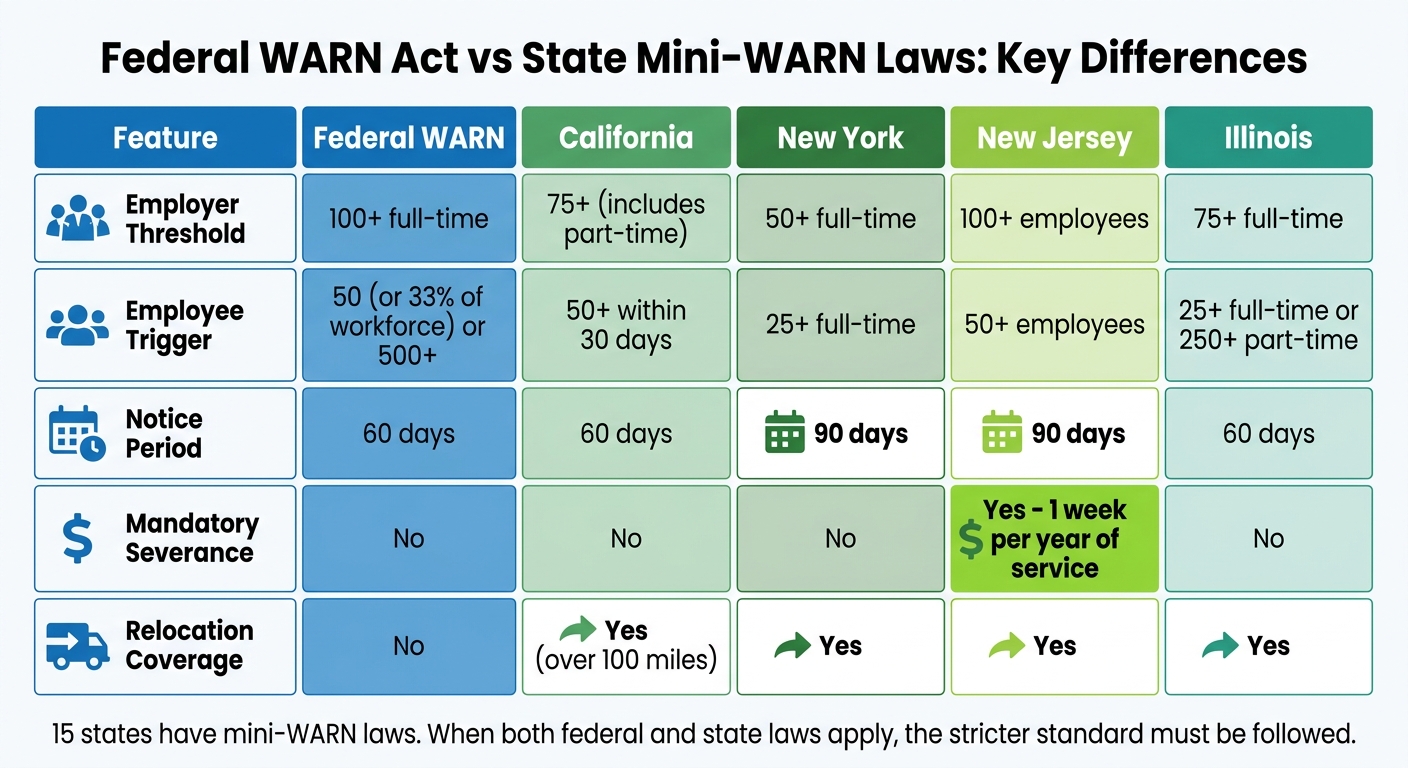
Federal WARN Act vs State Mini-WARN Laws Comparison Chart
In addition to federal WARN Act requirements, some states have introduced their own mini-WARN laws. These laws often go beyond the federal standards, offering more protections for workers. Currently, 15 states – including California, New York, New Jersey, Illinois, and Washington – have enacted such laws. These laws typically lower the thresholds for employer coverage, extend the notice periods, or broaden the criteria for triggering layoff notifications.
How Federal and State Laws Differ
The main differences between federal and state laws lie in employer thresholds and notice periods. The federal WARN Act applies to employers with 100 or more full-time employees, but many states lower this threshold. For instance, California’s law includes employers with 75 or more employees, counting both full-time and part-time workers, while New York’s threshold is 50 full-time employees.
Notice periods also vary widely. The federal law requires 60 days’ notice, but states like New York and New Jersey extend this to 90 days. On the other hand, Ohio‘s law, effective in 2025, requires only 3 working days’ notice for layoffs affecting 50 or more employees, even for small employers. The table below highlights some of these differences:
| Feature | Federal WARN | California | New York | New Jersey | Illinois |
|---|---|---|---|---|---|
| Employer Threshold | 100+ full-time | 75+ (includes part-time) | 50+ full-time | 100+ employees | 75+ full-time |
| Employee Trigger | 50 (or 33% of workforce) or 500+ | 50+ within 30 days | 25+ full-time | 50+ employees | 25+ full-time or 250+ part-time |
| Notice Period | 60 days | 60 days | 90 days | 90 days | 60 days |
| Mandatory Severance | No | No | No | Yes (1 week per year of service) | No |
| Relocation Coverage | No | Yes (over 100 miles) | Yes | Yes | Yes |
State Mini-WARN Law Examples
A few states stand out with unique provisions. New Jersey requires severance payments – one week for every year of service – making it one of only two states with such a rule. California’s Cal-WARN Act includes relocations of 100 miles or more as a trigger for notification, which isn’t addressed in the federal WARN Act.
Other states have introduced newer provisions. For example, New York updated its WARN Act in 2025 to require employers to disclose if artificial intelligence played a role in layoff decisions. Washington’s law, effective July 27, 2025, excludes employees on paid family or medical leave from being counted in mass layoff calculations.
How State Laws Affect Employer Obligations
Employers must navigate these state-specific requirements carefully, as they directly impact compliance obligations. When both federal and state laws apply, the stricter standard must be followed. For businesses operating in multiple states, this means assessing each state’s rules individually. For example, some states aggregate employees across locations to determine whether an employer is covered.
Additionally, state laws often dictate specific notification requirements. For instance, California mandates notice to its Employment Development Department, while Connecticut requires notifying its Dislocated Worker Unit. Employers need to incorporate these state-specific rules into their WARN compliance strategies to avoid legal penalties and potential damage to their reputation.
Employer Compliance and Best Practices
Steps for Ensuring Compliance
Start with the termination date and plan backward. To ensure compliance with WARN Act requirements, begin by identifying the termination date and count back 60 days for federal WARN or 90 days if state laws apply. This approach helps ensure you meet the notice deadlines and maintain proper documentation. When WARN planning is built into your reduction-in-force timeline, the risk of legal issues is significantly reduced.
Track workforce locations accurately. For remote employees, link their work locations to their reporting or assignment sites to determine if headcount thresholds are met. In multi-state operations, review the state-specific mini-WARN laws based on where employees physically work, not just the company’s headquarters. For example, California’s WARN threshold is 75 employees, while New York’s is 50, regardless of where the main office is located.
Pay close attention to the 90-day aggregation rule. Even smaller layoffs that don’t individually trigger WARN thresholds can require notice if aggregated over a rolling 90-day period and tied to the same business rationale. Keep detailed records of the reasons for each layoff round to demonstrate they are unrelated if challenged.
Ensure notices meet all requirements. Written notices should include critical details such as the first separation date, whether the layoff is permanent or temporary, the existence of bumping rights, and contact information for a company representative. Notices must be sent to affected employees (or their union), the state dislocated worker unit, and the local government’s chief elected official. Missing any required recipient could result in penalties of up to $500 per day.
Even with these measures, employers often encounter unexpected compliance hurdles.
Common Compliance Challenges
Misunderstanding employer thresholds is a frequent issue. Many employers overlook that state mini-WARN laws often set lower thresholds than federal requirements. For example, federal rules apply to companies with 100 or more employees, but states like California and Illinois set the bar at 75 employees, while New York’s threshold is 50. Additionally, states may count part-time employees differently, adding to the complexity.
The 90-day aggregation rule often surprises employers. Phased or staggered layoffs can unintentionally trigger WARN requirements if smaller rounds within a 90-day period collectively meet the threshold. Careful tracking is essential to avoid this pitfall.
Remote work locations can complicate compliance. Compliance is typically determined by the state where the employee physically works, not the company’s headquarters. Keeping detailed records of remote and hybrid work locations is critical to meeting state-specific requirements.
State final pay deadlines vary widely. While federal law requires final pay by the next regular payday, some states, like California and Massachusetts, mandate that all wages, bonuses, and accrued PTO be paid on the termination date. Missing these deadlines could lead to severe penalties, including treble damages in certain states.
Best Practices for Workforce Reductions
To address these challenges, adopting effective practices can help ensure compliance and reduce risks.
Engage legal counsel early. Given the complexities of the WARN Act – especially when dealing with staggered layoffs or counting separations – consulting with legal experts before announcing reductions is critical.
Use the strictest standard for multi-state operations. If your workforce spans multiple states, consider adopting policies that meet the most stringent requirements across all applicable jurisdictions. For instance, implementing a 90-day notice period and providing immediate final pay can simplify compliance and reduce risks.
Provide detailed written separation notices and consider severance options. Clear notices should include the separation date, final pay details, and information on benefits. Offering severance pay (e.g., 2–4 weeks) in exchange for a signed release can help mitigate the risk of lawsuits. For employees aged 40 and older, ensure compliance with the Older Workers Benefit Protection Act by offering a 45-day consideration period for group layoffs and a 7-day revocation period.
Address potential violations quickly. If a WARN violation is identified, promptly paying back wages and benefits – ideally within three weeks of the layoff – can help minimize penalties. For example, failing to provide notice for a layoff of 200 employees could result in back pay exposure of approximately $1.2 million.
Penalties for Non-Compliance
Employers must grasp the penalties tied to non-compliance with WARN regulations to avoid hefty financial losses and damage to their reputation during mass layoffs.
Legal and Financial Penalties
Back pay and benefits are the most immediate financial risks. Employers who violate WARN may owe up to 60 days’ worth of back pay and benefits covered under ERISA. The amount is calculated based on the higher of the employee’s average pay rate over the last three years or their final regular pay rate.
Civil penalties for failing to notify local authorities can add up quickly. Companies that neglect to inform local government officials could face fines of $500 per day. However, these penalties can be waived if all back pay and benefits owed to affected employees are paid within three weeks.
Enforcement relies on private lawsuits, which can be costly. Since the U.S. Department of Labor does not enforce WARN, violations are handled through private lawsuits in U.S. District Courts. This means employers not only face back pay and civil penalties but could also be ordered to cover the plaintiff’s attorney’s fees. As noted by the Department of Labor:
“The Department of Labor has no enforcement authority under WARN and does not investigate complaints or bring suits to enforce WARN”.
State-level WARN laws can impose even stricter penalties. States like New Jersey and Maine require mandatory severance payments, often amounting to one week of pay for every year of service. New Jersey even adds an extra four weeks of pay for failing to meet the 90-day notice rule. Unlike federal WARN, which doesn’t require severance, California’s Cal-WARN only allows prevailing employees to recover attorney’s fees.
| Penalty Type | Federal WARN Act | California (Cal-WARN) | New Jersey WARN |
|---|---|---|---|
| Back Pay Liability | Up to 60 days | Up to 60 days | Up to 90 days |
| Civil Penalty | $500/day | $500/day | Varies by state enforcement |
| Mandatory Severance | N/A | N/A | 1 week per year of service |
| Attorney’s Fees | Prevailing party | Prevailing employee | Prevailing employee |
These legal and financial risks are just one part of the picture. Employers must also consider the broader reputational consequences of non-compliance.
Reputational Risks
Ignoring WARN requirements doesn’t just hit the bottom line – it can also harm a company’s public image and future operations.
Public lawsuits can tarnish a company’s reputation. WARN violations are resolved in U.S. District Courts, making cases a matter of public record. This can attract unwanted media attention. Additionally, WARN notices are often published online by state agencies, further increasing scrutiny. A poor track record with labor laws or layoffs can make it harder to attract skilled talent in the future.
Failing to notify local officials can damage community relations. When local governments aren’t informed, communities are left unprepared for the economic impact of layoffs. This can strain relationships with local leaders and disrupt the efforts of state “Rapid Response” units, which help dislocated workers transition to new opportunities.
Employee trust takes a hit when proper notice isn’t given. Denying workers the 60-day transition period to find new jobs or retrain can lead to resentment among both departing and remaining employees. This erosion of trust can make it harder to retain current staff and attract new hires in the future.
Recent Developments and Legislative Updates
Mass layoff regulations are shifting quickly, driven by economic changes, the rise of remote work, and the growing impact of automation. Both federal and state governments are introducing updates that could significantly alter how employers handle layoffs and protect workers.
Proposed Changes to the WARN Act
The Fair Warning Act (H.R. 5761) represents the most significant federal update since 1988. This bill, introduced by House Democrats, proposes extending the required layoff notice period from 60 to 90 days. It also lowers the threshold for employer coverage from 100 employees to 50 employees or businesses with annual payrolls of $2 million or more.
The definition of mass layoffs and site closings would be expanded. Under this proposal, a “mass layoff” would occur if 10 or more employees are let go at a single site or if 250 employees are laid off company-wide, removing the current percentage-based requirement. Similarly, site closings would apply to facilities with just 5 employees, down from the current 50-employee threshold.
Remote workers are explicitly included under the new rules. The act clarifies that remote employees count if they report to, are trained by, or are assigned to a specific site. John Philo, Executive and Legal Director of the Sugar Law Center for Economic and Social Justice, highlighted the importance of this update:
“The act needs to be updated to account for more dispersed workforces, including some dominated by remote employees”.
Stronger penalties aim to enforce compliance. Employers violating the proposed rules would face 30 days of liquidated damages in addition to back pay and benefits. Rep. Emilia Sykes, who sponsored the bill, stressed the need for accountability:
“What’s a law if you don’t have any enforcement mechanism? The existing law has no teeth”.
The timing coincides with rising layoff activity and legal challenges. In October 2025 alone, more than 39,000 workers received WARN notices. Between May 2025 and May 2026, over 200 lawsuits citing WARN Act violations were filed in federal courts. Additionally, the Federal Reserve Bank of Cleveland reported over 40,000 WARN notices in May 2025, the highest number since the 2020 pandemic. These federal efforts align with similar actions at the state level, as outlined below.
State-Level Legislative Trends
While federal reforms are still in progress, states are taking the lead in strengthening worker protections. States are outpacing federal lawmakers in updating layoff notification laws. Ohio (HB 96) and Washington (SB 5525) passed new mini-WARN laws in 2025, joining 15 states with stricter requirements than the federal WARN Act.
AI-triggered layoffs are now under scrutiny. New York became the first state to require employers to disclose whether artificial intelligence or automation tools prompted a mass layoff. California’s SB 617 also requires notices to include information about retraining programs and food assistance resources.
Mandatory severance pay is gaining traction. States like New Jersey, Hawaii, and Maine now require severance payments – typically one week of pay for each year of service – regardless of whether proper notice was given. New Jersey’s 2023 amendments have become a model for other states considering similar measures.
Confusing language in some state laws adds to compliance challenges. For instance, Ohio’s HB 96, which took effect in September 2025, includes unclear provisions about whether the federal 33% workforce reduction qualifier applies to its 50-employee threshold. John R. Cernelich, Co-chair for Labor and Employment at Calfee, Halter & Griswold LLP, expressed frustration:
“Perhaps in Ohio we’ve expanded on the WARN obligations, but perhaps we didn’t… It’s frustrating for employers”.
Multi-state employers face growing compliance complexity. With varying notice periods, employee thresholds, and severance requirements across states, companies must adhere to the “highest standard” among applicable laws. As Cernelich pointed out:
“Compliance gets more complicated as more states adopt their own laws, some of which differ from the federal WARN Act”.
Conclusion
This section underscores the importance of adhering to WARN Act requirements and planning ahead to manage layoffs effectively.
Main Takeaways
Complying with mass layoff regulations isn’t optional. Under the federal WARN Act, employers with 100 or more full-time employees must provide a 60-day notice before plant closures or mass layoffs. Some states have their own mini-WARN laws, which may demand even stricter requirements, such as longer notice periods or mandatory severance.
Navigating compliance is becoming increasingly challenging. Employers must juggle multiple obligations, including sending written notices to various stakeholders and meeting state-specific rules. Missing these steps – like failing to notify local governments – can lead to civil penalties of up to $500 per day of non-compliance.
For employees, awareness is their best defense. Since the U.S. Department of Labor doesn’t enforce the WARN Act, employees must take action themselves. This often involves filing private or class-action lawsuits in U.S. District Courts, where successful plaintiffs may recover attorney’s fees.
These insights provide a foundation for actionable steps that both employers and employees can take to navigate this complex landscape.
Final Thoughts for Employers and Employees
Whether you’re an employer or an employee, proactive steps are key when dealing with layoffs. Employers should integrate compliance into their planning process early. This includes working backward from the planned termination date to meet notice deadlines, documenting exceptions as they arise, and identifying the reporting sites of remote employees before conducting workforce assessments.
For employees, understanding your rights under federal and state laws is critical – especially provisions like the 90-day aggregation rule. Employers, on the other hand, can reduce legal risks and maintain goodwill by offering severance in exchange for claim releases and maintaining open, transparent communication during these transitions. Thoughtful planning and clear communication can help ease the legal and emotional challenges of layoffs.
FAQs
Do remote workers count toward WARN thresholds?
Yes, remote workers are counted under WARN thresholds if they are tied to a specific site of employment that fits the law’s criteria. For instance, if a mass layoff or plant closure impacts 50 or more full-time employees at a single location, remote workers assigned to that site are included. Employers must thoroughly review how their workforce is structured to stay compliant with WARN regulations.
When can layoffs be combined under the 90-day rule?
The WARN Act includes a provision known as the 90-day rule, which allows employers to combine layoffs occurring within a 90-day period under certain conditions. For example, if a short-term layoff initially expected to last less than six months is later extended beyond that timeframe, it may trigger the requirement for advance notice. This rule helps ensure that employers remain compliant with notification guidelines for mass layoffs or significant workforce reductions.
How do I know if my state requires more than 60 days’ notice?
Some states have their own versions of WARN laws, which may require longer notice periods or include different provisions compared to the federal 60-day rule. For instance, California has its own WARN law that offers added protections for employees. That said, most states stick to the federal standard. It’s important to review your state’s specific regulations to understand the requirements where you operate.