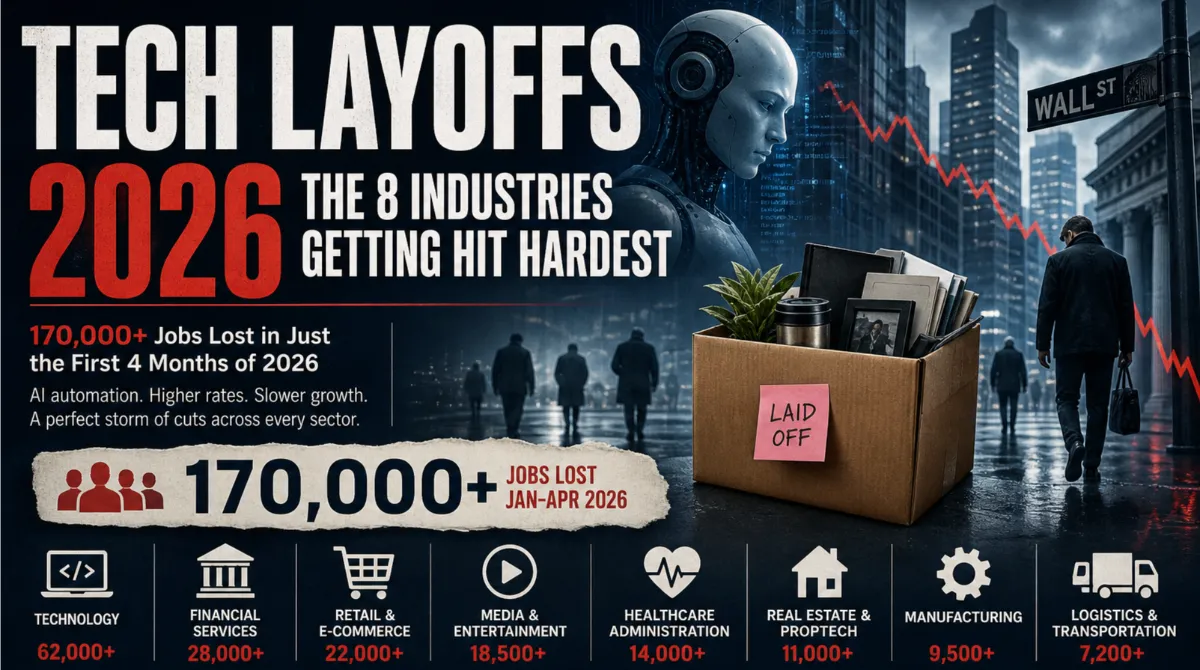
In the first four months of 2026, more than 170,000 workers across eight major industries have already lost their jobs, with tech layoffs 2026 accounting for the single largest share of workforce reductions globally. From Silicon Valley giants to Wall Street banks and legacy retail chains, the wave of cuts that began in late 2025 has accelerated sharply — driven by AI-driven automation, rising interest rates, post-pandemic demand normalization, and a cautious macroeconomic outlook that has corporate boards trimming headcount at a pace not seen since the 2022–2023 tech correction.
This article breaks down the eight industries hit hardest, names the companies leading each wave of cuts, and gives workers the data they need to understand what’s happening — and what comes next.
The Broader Layoff Landscape: Tech Layoffs 2026 in Context
Before diving into individual industries, it’s worth understanding the scale of what’s unfolding. According to Bureau of Labor Statistics JOLTS data, mass layoff events — defined as 50 or more initial UI claims filed against a single employer — have risen meaningfully compared to the same period in 2025. While the overall unemployment rate remained relatively stable at 4.2% as of March 2026, that headline number masks a surge in white-collar, knowledge-worker displacement that is concentrated in specific sectors.
The Department of Labor’s WARN Act filings, which require employers with 100 or more employees to provide 60 days’ notice before mass layoffs, have been filing at elevated rates through Q1 2026. You can monitor those filings directly through the U.S. Department of Labor layoffs and workforce reductions page. The pattern is clear: technology, finance, retail, media, healthcare administration, real estate, manufacturing, and logistics are the eight sectors bearing the brunt of early 2026 restructurings.
For an overview of which roles are growing despite the carnage, see our guide to the fastest-growing jobs of 2026, which identifies the fields absorbing displaced workers most effectively. And for those navigating benefits questions after a sudden job loss, our complete guide to health insurance after being laid off walks through every option available under COBRA, Medicaid, and ACA marketplace plans.
| Industry | Estimated Layoffs (Jan–Apr 2026) | Key Companies Cutting | Primary Driver |
|---|---|---|---|
| Technology | 62,000+ | Amazon, Microsoft, Salesforce, Intel | AI restructuring, cost optimization |
| Financial Services | 28,000+ | Citigroup, Goldman Sachs, Morgan Stanley | Rate environment, fintech disruption |
| Retail & E-Commerce | 22,000+ | Macy’s, Gap Inc., Wayfair | Demand normalization, digital shift |
| Media & Entertainment | 18,500+ | Warner Bros. Discovery, Paramount, BuzzFeed | Streaming consolidation, ad revenue decline |
| Healthcare Administration | 14,000+ | Cigna, CVS Health, Walgreens | Regulatory pressure, automation |
| Real Estate & Proptech | 11,000+ | Opendoor, Redfin, WeWork spinoffs | High interest rates, volume decline |
| Manufacturing | 9,500+ | Ford, 3M, Whirlpool | Automation, EV transition costs |
| Logistics & Transportation | 7,200+ | UPS, FedEx, Yellow Corp. remnants | Volume normalization, route optimization |
1. Technology: The Epicenter of Tech Layoffs 2026
No industry has made more headlines in early 2026 than technology. The sector has shed an estimated 62,000 jobs in the first four months of the year alone, continuing a restructuring cycle that has now lasted three consecutive years. What makes the current wave distinctive is not just its scale but its stated rationale: nearly every major tech company has explicitly cited AI-driven productivity gains as the justification for reducing headcount in software engineering, product management, and customer support roles.
Amazon Web Services announced in January 2026 that it would eliminate approximately 14,000 positions across its cloud infrastructure, developer tools, and enterprise support divisions, citing the automation of routine operations tasks through its internal AI tooling. For a detailed breakdown of that announcement and what it means for AWS employees, see our AWS layoffs 2025 guide, which has been updated with the most recent 2026 data. Microsoft followed in February with cuts affecting around 6,000 employees — approximately 3% of its global workforce — concentrated in Azure consulting, LinkedIn product teams, and its gaming division following the full integration of Activision Blizzard.
Salesforce, which had already conducted significant layoffs in 2023 and 2024, returned in March 2026 with another round targeting roughly 3,500 employees in its professional services and legacy CRM support functions. The company’s CEO Marc Benioff publicly stated that Salesforce’s new AI agent platform, Agentforce, had reduced the need for human customer success representatives by a measurable percentage. Intel, meanwhile, announced in February that its ongoing restructuring would result in an additional 5,000 job eliminations on top of the 15,000 cuts it announced in 2024, as the chipmaker continues to lose ground to Nvidia and AMD in the AI accelerator market.
Why AI Is Accelerating the 2026 Tech Layoff Cycle
The core dynamic reshaping employment in technology is not a demand slump — it is a substitution effect. Companies like Klarna have publicly claimed that AI tools have allowed them to reduce their customer service workforce from over 700 agents to fewer than 50 in certain markets. GitHub Copilot and similar code-generation tools are enabling engineering teams to maintain or increase output with fewer full-time developers. According to research from large language model deployment studies, enterprise adoption of AI coding assistants grew by roughly 180% between 2024 and early 2026, compressing the junior-to-mid level software engineering job market significantly.
This creates a painful paradox for tech workers: the industry is booming in terms of revenue and stock price, but it is simultaneously eliminating the roles that once served as entry points for the middle class into high-income careers.
2. Financial Services: Wall Street’s Quiet Restructuring
The financial services sector has cut more than 28,000 jobs through April 2026, with the largest share of cuts coming from traditional banking institutions attempting to reduce cost-to-income ratios that ballooned during the pandemic-era hiring surge. Citigroup has been the most aggressive, continuing its sweeping “Transformation” restructuring that has now eliminated more than 40,000 positions globally since 2023, including approximately 7,000 new cuts announced in January 2026 affecting its middle-office operations in New York, Tampa, and London.
Goldman Sachs cut approximately 3,200 employees in Q1 2026, primarily from its consumer banking division (which it has been winding down since the failure of Marcus) and its transaction banking unit, where automation has reduced the need for human reconciliation specialists. Morgan Stanley announced in March that it would eliminate 2,000 positions from its wealth management technology and operations arms, redirecting investment toward its own proprietary AI-assisted advisory tools.
For context on what these layoffs mean for early 2026 broadly, see our coverage of layoffs in 2026: from Meta to Citi, which provides a month-by-month timeline of the biggest announcements since January 1.
The Rate Environment’s Role in Finance Sector Cuts
Despite the Federal Reserve’s gradual rate normalization cycle, mortgage origination volumes remain suppressed compared to 2020–2021 levels, meaning mortgage-heavy banks and servicers continue to operate with excess capacity on their origination and servicing floors. Wells Fargo, which has quietly reduced headcount by more than 50,000 over three years, announced an additional 1,800 cuts in its home lending division in February 2026. The combination of persistent rate sensitivity and aggressive AI-driven back-office automation makes financial services a sector where structural employment declines are likely to continue through the remainder of 2026.
3. Retail and E-Commerce: The Long Reckoning Continues
Retail job losses in early 2026 have exceeded 22,000, with a sharp divide between companies investing in omnichannel digital transformation and those still operating legacy store formats with high fixed costs. Macy’s announced in January that it would close an additional 66 stores on top of the 150 it had already committed to shutting down, affecting an estimated 4,800 store-level and corporate employees. The company described the cuts as part of its “Bold New Chapter” strategy, which prioritizes its luxury Bloomingdale’s and Bluemercury banners over the flagship department store format.
Gap Inc. cut approximately 1,800 corporate positions in February, primarily from its San Francisco headquarters and its Old Navy technology team, as the apparel group consolidates its digital and logistics operations. Wayfair, the online home goods retailer that has now conducted multiple rounds of layoffs since 2022, eliminated 340 additional technology and customer operations roles in March as it works toward sustained profitability. Kohl’s announced store closures and associated headcount reductions totaling roughly 2,000 employees in Q1 2026, while Party City completed its final wind-down following its second bankruptcy, displacing nearly 6,800 workers across its remaining store locations.
4. Media and Entertainment: Streaming Consolidation Takes Its Toll
The media and entertainment industry has seen over 18,500 layoffs in the first four months of 2026, a figure that reflects the brutal reckoning underway as streaming platforms consolidate, advertising revenues remain unpredictable, and legacy linear television continues its long structural decline. Warner Bros. Discovery completed a second major restructuring in early 2026 after its merger integration continued to produce cost-saving targets, eliminating approximately 2,500 positions from its CNN, Max, and studio operations. Paramount Global, in the midst of its merger with Skydance Media, cut around 2,000 employees from its legacy Paramount+ streaming team and Nickelodeon/MTV Networks divisions.
BuzzFeed formally shut down its BuzzFeed News brand in early 2026 following years of restructuring, while its remaining content operations were dramatically scaled back, affecting hundreds of editorial and production workers. Disney, which had already cut 7,000 jobs globally in 2023, made smaller but targeted cuts in Q1 2026 of approximately 800 positions from its parks-adjacent retail and technology teams. The cuts at NBCUniversal, now a unit of Comcast, totaled roughly 1,200 positions from its streaming and local broadcast divisions.
Why Digital Ad Revenue Isn’t Saving Media Jobs
The persistent assumption that digital-first media organizations would weather the storm better than print or linear television has proven optimistic. Even media companies with strong social and digital presences are finding that programmatic advertising rates have softened in 2026, and that AI-generated content is depressing the per-article economics for publishers who once relied on high-volume content production as a revenue strategy. The structural challenges facing the industry are explored in depth in the ongoing coverage at the Wikipedia overview of journalism job losses in the United States.
5. Healthcare Administration: A Sector Under Pressure from Multiple Directions
Healthcare is one of the more surprising entries on this list, given that clinical employment in nursing, primary care, and allied health professions remains robust. The pain is concentrated in healthcare administration, insurance, pharmacy benefits management, and retail health — areas where over 14,000 jobs have been eliminated in the first four months of 2026. CVS Health announced in January that it would cut 2,900 corporate and administrative positions as it restructures its health services division and scales back its HealthHUB clinic format, which failed to achieve the patient volume needed for profitability. Cigna Group cut approximately 1,700 roles from its administrative and claims processing operations in Q1, explicitly citing AI-assisted prior authorization and claims adjudication tools as enabling the reduction.
Walgreens, which has been navigating a retail pharmacy crisis driven by reimbursement rate pressure and front-of-store competition from Amazon and Walmart, continued its multi-year restructuring by announcing additional store closures affecting approximately 3,500 jobs in Q1 2026. Optum, the health services subsidiary of UnitedHealth Group, eliminated roughly 1,400 positions from its analytics and care management teams in February, while Centene Corporation cut approximately 900 administrative roles as part of a broader operational efficiency initiative.
Workers in healthcare administration who are facing layoffs and concerned about coverage gaps should review our guide to health insurance after being laid off, which is particularly relevant for those who have worked in the insurance industry itself and may be surprised to find they need to navigate the same system from the other side. Additionally, workers who have experienced layoffs during pregnancy or parental leave should read our article on whether you can get laid off while on maternity leave, as healthcare sector layoffs have disproportionately affected women in mid-career administrative roles.
6. Real Estate and Proptech: The Rate Hangover Persists
The real estate sector’s employment correction, which began when mortgage rates surged above 7% in 2022 and 2023, has not yet fully resolved. With rates remaining elevated in early 2026 — the 30-year fixed averaging between 6.5% and 6.9% through the first quarter — transaction volumes remain well below historical norms, and the proptech companies that built their business models on the assumption of rapid housing market turnover continue to struggle. Opendoor Technologies, the iBuying pioneer, reduced its workforce by approximately 1,200 employees in early 2026, representing a dramatic reduction from its peak headcount of over 20,000 in 2021. The company’s market capitalization has fallen by more than $18 billion from its 2021 highs.
Redfin, the technology-enabled real estate brokerage, made additional cuts of roughly 400 employees in Q1 2026, concentrating the reductions in its mortgage lending and title services divisions. Compass, the high-end residential brokerage, eliminated approximately 600 corporate technology and operations roles while maintaining its agent count, reflecting the tension between the company’s ambitions to be a technology company and the reality that its core business remains reliant on human agents in a volume-constrained market.
7. Manufacturing: Automation and the EV Transition Reshape the Factory Floor
Manufacturing job losses of approximately 9,500 in early 2026 reflect two distinct dynamics: the ongoing automation of repetitive production tasks and the specific disruption caused by the automotive industry’s uneven transition to electric vehicles. Ford Motor Company, which has been managing EV-related restructuring since 2023, announced an additional 800 production and engineering eliminations in Q1 2026 at its Michigan facilities, tied to the scaling of its Ford Pro commercial vehicle electrification program and associated changes in powertrain assembly requirements. The company has now eliminated over 8,000 positions since announcing its EV investment strategy in 2022.
3M Company, the diversified manufacturer, continued the restructuring begun after its spinoff of Solventum in 2024, cutting approximately 1,500 positions from its corporate and shared services functions in Q1 2026. Whirlpool, the appliance manufacturer dealing with softened global housing demand, reduced its workforce by around 1,000 employees in North America in February, closing a manufacturing facility in Indiana. General Electric’s aviation spinoff, GE Aerospace, made smaller targeted cuts of approximately 400 positions in its supply chain and finance teams.
The manufacturing sector’s employment trajectory through 2026 is closely linked to broader trade and tariff policy, which has been in flux. Workers and analysts tracking manufacturing employment can find authoritative data through the BLS manufacturing industry at a glance page, which is updated monthly.
8. Logistics and Transportation: Post-Pandemic Volume Correction Continues
The logistics and transportation sector, which expanded dramatically during the pandemic-era e-commerce surge, shed approximately 7,200 jobs in the first four months of 2026 as parcel volumes stabilize at levels below the 2020–2021 peak and major carriers continue optimizing their networks. UPS, which has been the most aggressive cutter among major carriers, announced in January 2026 that it would eliminate an additional 4,000 management and corporate roles as part of its “Efficiency Reimagined” program, building on the 12,000 cuts it made in 2024. The company’s CEO explicitly cited investments in AI-powered route optimization, automated sorting facilities, and drone delivery pilot programs as factors reducing the need for traditional logistics planning roles.
FedEx, which has been consolidating its Express, Ground, and Freight networks since 2023, made additional targeted cuts of approximately 1,200 positions from its corporate IT and customer operations teams in Q1 2026. The company’s multi-year DRIVE cost-saving initiative, targeting $4 billion in annual savings, continues to drive headcount reductions across its back-office functions. Smaller logistics providers, including several regional less-than-truckload carriers operating in the aftermath of Yellow Corporation’s 2023 bankruptcy, also reported reductions as capacity surplus in the trucking industry continued to pressure freight rates.
| Company | Industry | Layoff Announcement Date | Employees Affected | Stated Reason |
|---|---|---|---|---|
| Amazon Web Services | Technology | January 2026 | ~14,000 | AI automation, restructuring |
| Citigroup | Financial Services | January 2026 | ~7,000 | Transformation program continuation |
| Microsoft | Technology | February 2026 | ~6,000 | Post-Activision integration, AI shift |
| Intel | Technology | February 2026 | ~5,000 | Competitive restructuring |
| Warner Bros. Discovery | Media & Entertainment | January–February 2026 | ~2,500 | Merger integration cost savings |
| UPS | Logistics | January 2026 | ~4,000 | AI route optimization, automation |
| Macy’s | Retail | January 2026 | ~4,800 | Store closures, strategy pivot |
| CVS Health | Healthcare Admin | January 2026 | ~2,900 | HealthHUB restructuring |
| Salesforce | Technology | March 2026 | ~3,500 | Agentforce AI deployment |
| Paramount Global | Media & Entertainment | February 2026 | ~2,000 | Skydance merger integration |
What Laid-Off Workers Should Do Right Now
If you’ve been affected by any of the layoffs described above, the most immediate priority is understanding your benefits, severance rights, and state unemployment insurance options. Workers in California should bookmark the California Employment Development Department unemployment portal, which provides information on filing claims, benefit amounts, and eligibility. Workers in other states can find their state’s unemployment insurance portal through the Department of Labor’s unemployment insurance resources page.
On the healthcare coverage question — one of the most pressing for newly laid-off workers — COBRA allows you to continue your employer’s group health plan for up to 18 months, though you’ll typically pay 100% of the premium plus a 2% administrative fee. For many workers, ACA marketplace plans will be significantly more affordable, particularly for those whose income will be lower in the months following a layoff. Our comprehensive guide on health insurance after being laid off covers every option in detail.
Workers who were laid off during pregnancy or parental leave face additional legal complexities. While employers can legally conduct layoffs that affect employees on leave in most circumstances, there are important protections and notice requirements that vary by state. Our article on whether you can get laid off while on maternity leave walks through the federal and state-level protections in detail.
Looking Ahead: Will the Layoff Wave Continue Through Mid-2026?
Most labor economists tracking the current cycle expect the pace of tech layoffs 2026 and cross-sector restructurings to continue at elevated rates through at least Q2 2026, with a possible deceleration in the second half of the year if consumer spending stabilizes and corporate earnings guidance improves. The wild card remains AI-driven displacement: unlike previous technology transitions — such as the internet or mobile revolutions — the current wave of AI adoption is compressing tasks at both the entry level and senior contributor level simultaneously, which makes the employment impact harder to predict and harder to offset through retraining programs alone.
Industries that appear best positioned to absorb displaced workers through the remainder of 2026 include advanced manufacturing tied to domestic semiconductor production (spurred by CHIPS Act investment), healthcare delivery at the clinical level, infrastructure construction, and the emerging AI operations and prompt engineering space. For a comprehensive look at which specific roles are growing, our guide to the fastest-growing jobs of 2026 provides role-by-role salary data, growth projections, and reskilling pathways.
“The current restructuring cycle is unlike prior downturns because companies are not laying off workers due to falling revenues — in many cases, revenues are rising. They are laying off workers because the marginal productivity of an AI system is now competitive with the marginal productivity of a human employee in a growing range of tasks. That is a structural shift, not a cyclical one.” — Labor economist commentary widely cited in Q1 2026 earnings season analysis
The political implications of this dynamic are already being felt. Several states have introduced legislation requiring advance notice periods longer than the federal WARN Act’s 60-day minimum, and there are renewed calls in Congress for updating the WARN Act itself — which has not been substantially amended since its 1988 passage — to reflect the realities of modern mass layoffs, including digital notification requirements and extended notice periods for AI-driven restructurings. Workers and advocates can track these legislative developments through our ongoing coverage at GoLayoffs.com.
Track layoffs and the job market
FAQ
Which industry has the most layoffs in early 2026?
Technology is the hardest-hit industry by a significant margin, with an estimated 62,000 layoffs in the first four months of 2026. The biggest contributors include Amazon Web Services (~14,000), Microsoft (~6,000), Intel (~5,000), and Salesforce (~3,500). The primary driver is AI-driven restructuring, with companies explicitly citing automation of software development, customer support, and back-office operations as justification for reducing headcount even in periods of revenue growth.
Are tech layoffs 2026 worse than 2023?
In terms of raw numbers, early 2026 is tracking at a pace comparable to — though not yet exceeding — the peak months of the 2022–2023 tech correction. What distinguishes 2026 is the stated rationale: in 2022–2023, layoffs were primarily driven by post-pandemic demand normalization and over-hiring corrections. In 2026, a significant portion of cuts are explicitly tied to AI automation replacing job functions, which suggests the displacement may be more permanent in nature rather than cyclical.
What benefits am I entitled to after a tech layoff in 2026?
Your entitlements depend on your employer, your state, and your employment contract. At minimum, federal law requires employers covered by the WARN Act (100+ employees) to provide 60 days’ advance written notice before a mass layoff, or pay equivalent wages and benefits in lieu of notice. Beyond that, you are typically eligible for state unemployment insurance (benefit amounts and durations vary by state), COBRA continuation health coverage for up to 18 months, and any severance your employer has contractually committed to provide. California residents have additional protections under the state’s WARN Act, which applies to employers with 75 or more employees.
Which tech companies are most likely to announce further layoffs in the second half of 2026?
Based on current restructuring timelines, public earnings guidance, and WARN Act filings, analysts are monitoring companies including Intel (which has a multi-year restructuring plan still in progress), several mid-sized software-as-a-service companies facing revenue compression, and media conglomerates still working through merger integrations. That said, layoff predictions are inherently uncertain — companies that appear stable can announce sudden restructurings following a disappointing earnings quarter, a strategic pivot, or a major acquisition. Following WARN Act filings through the Department of Labor and checking GoLayoffs.com for real-time updates is the best way to stay informed.
Is it harder to find a new job after a tech layoff in 2026 compared to previous years?
For entry-level and mid-level software engineering roles, the job market in 2026 is meaningfully more competitive than it was in 2021 or even 2023. AI coding tools have reduced demand for junior developers, and the supply of available candidates remains elevated after three years of tech sector layoffs. That said, roles requiring AI integration expertise, machine learning operations, cybersecurity, and product management with AI product experience remain in strong demand.
Workers displaced from traditional software engineering roles who pivot toward AI-adjacent skills within six to twelve months of their layoff are generally finding comparable or better compensation. Our guide to the fastest-growing jobs of 2026 provides specific data on which roles are hiring and at what salary bands.
Latest: HubSpot is cutting nearly 660 jobs (about 7% of its workforce), according to its October 6, 2026 SEC filing.
Live tracker: every tech layoff announced in 2026, with the company’s own numbers and a link to the source, is in our Tech Layoff Tracker 2026.