
Amazon‘s 2026 layoffs are the company’s largest ever, cutting 30,000 corporate roles within four months. Despite reporting a 14% increase in net sales in late 2025, Amazon eliminated 9% of its corporate workforce, focusing on streamlining operations and planning about $200 billion in capital expenditures in 2026, much of it for AI and automation. These cuts primarily affected technical, managerial, and creative roles while leaving warehouse staff untouched.
Key points:
- 30,000 layoffs: 16,000 in January 2026 and 14,000 in October 2025.
- Focus areas: AWS, Alexa AI, Prime Video, and Amazon Fresh.
- Reason: Restructuring for efficiency, reducing layers of management, and reallocating funds to AI infrastructure.
- Impact: Severance packages offered; affected workers face tough job markets, especially in management roles.
- Future hiring: 11,000 AI-focused roles planned for 2026.
Amazon’s pivot reflects a broader trend in tech, prioritizing automation and AI while reshaping workforce needs.
Amazon Employee Speaks (Layoffs 2026)
Layoff Numbers and Distribution
Amazon 2026 Layoffs: 30,000 Job Cuts by Numbers and Distribution
Live tracker: every tech layoff announced in 2026, with the company’s own numbers and a link to the source, is in our Tech Layoff Tracker 2026.
Total Layoffs Announced in 2026
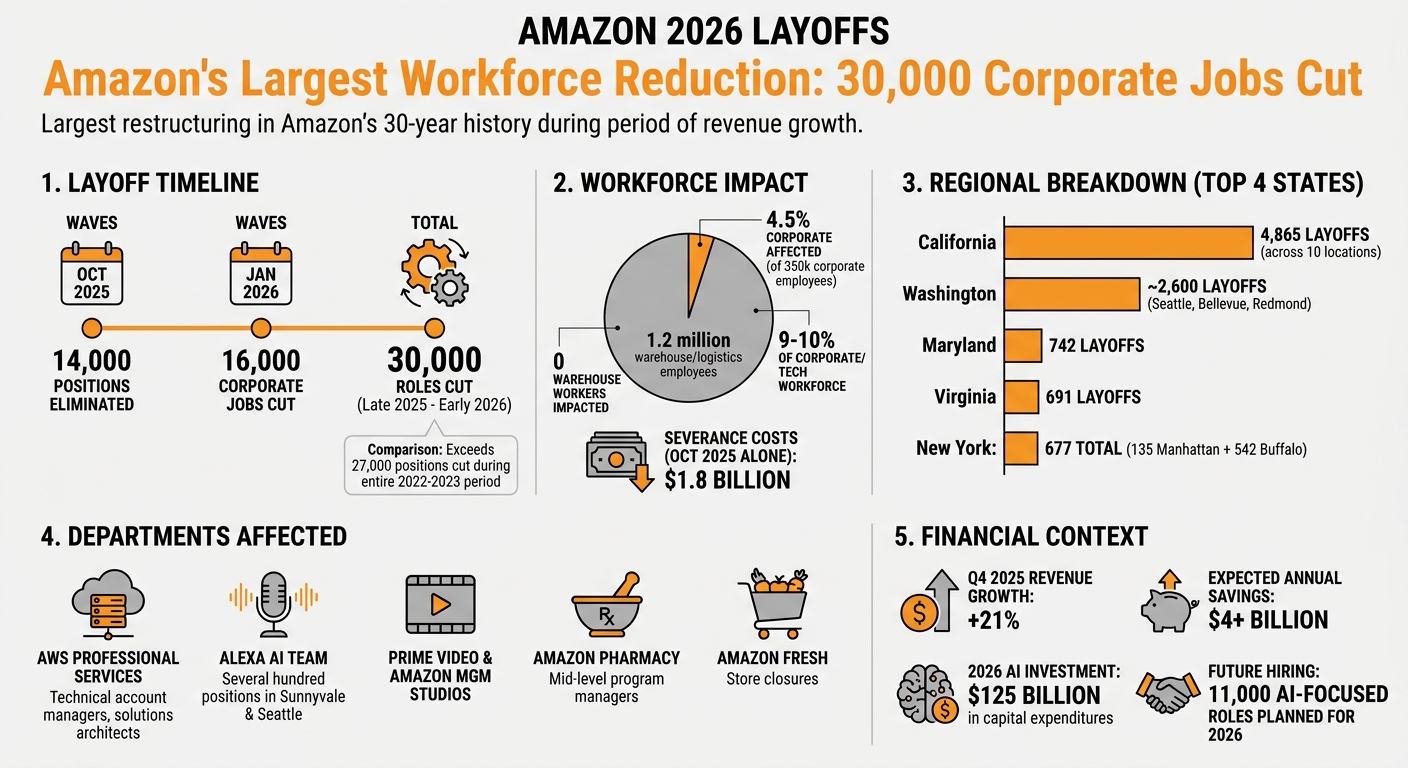
In January 2026, Amazon revealed plans to cut 16,000 corporate jobs. This marked the second major wave of layoffs in just four months. When combined with the 14,000 positions eliminated in October 2025, the total reached 30,000 roles cut between late 2025 and early 2026. To put this in perspective, these cuts surpassed the 27,000 positions eliminated during the entire 2022–2023 period, making it the largest workforce reduction in Amazon’s history.
The January 2026 layoffs represented about 4.5% of Amazon’s 350,000-person corporate workforce. However, the company’s 1.2 million warehouse and logistics employees were not impacted. For the October 2025 layoffs alone, Amazon reported $1.8 billion in severance costs. Below, we’ll dive into how these layoffs were distributed across departments and regions.
Breakdown by Department and Region
The 2026 layoffs hit several major divisions. AWS Professional Services saw reductions in roles like technical account managers and solutions architects. Meanwhile, the Alexa AI team lost several hundred positions in Sunnyvale and Seattle as Amazon shifted its focus to its LLM-native Rufus product. Cuts also extended to Prime Video and Amazon MGM Studios, driven by post-integration consolidation efforts, while Amazon Pharmacy reduced mid-level program manager roles.
Regional impacts were especially severe in physical retail operations. California bore the brunt, with 4,865 layoffs across 10 locations, largely due to Amazon Fresh store closures. Washington state reported roughly 2,600 layoffs in the Seattle, Bellevue, and Redmond areas, with over half of these affecting product and engineering roles. Maryland saw 742 layoffs tied to five Amazon Fresh store closures, and Virginia reported 691 job cuts. In New York, 135 corporate roles were eliminated in Manhattan, while Buffalo faced an additional 542 layoffs scheduled for May 30, 2026.
These layoffs, varying significantly by division and region, illustrate a long-term trend that has been building since 2022.
Layoff Trends Since 2022
Amazon’s workforce reductions have steadily intensified over the years. Between 2022 and 2023, the company cut 27,000 positions as part of a post-pandemic adjustment. After smaller, more targeted layoffs in 2024, the pace picked up dramatically in late 2025, culminating in the aggressive restructuring seen in 2026.
What makes the 2026 layoffs different is their strategic focus. Unlike earlier rounds, which were largely driven by economic pressures, these cuts occurred during a period of growth – Amazon reported a 14% increase in net sales in Q4 2025. The company has been streamlining management layers and eliminating bureaucratic roles while simultaneously guiding to about $200 billion in capital expenditures in 2026 across AI, chips, robotics and other areas. As CEO Andy Jassy explained:
In the next few years, we expect that [AI] will reduce our total corporate workforce as we get efficiency gains from using AI extensively across the company.
Why Amazon Cut Jobs in 2026
Corporate Restructuring and Efficiency Targets
Amazon’s CEO, Andy Jassy, spearheaded a major effort to streamline the company’s operations and reshape it into what he described as the “world’s largest startup”. This initiative aimed to cut through layers of management that had slowed decision-making and stifled innovation. The rapid growth Amazon experienced between 2020 and 2022 had led to a bloated structure, with too many managers overseeing too few employees.
To tackle this issue, Amazon set internal goals to simplify its hierarchy and even introduced a “no bureaucracy email alias” where employees could report inefficient processes. The restructuring effort focused on fostering a “culture of ownership”, encouraging managers to take a more hands-on approach rather than just supervise. By eliminating 30,000 roles, Amazon expects to save over $4 billion annually in salaries and benefits. These savings are being redirected toward record-breaking capital investments, of about $200 billion in 2026.
Economic Pressures and Market Changes
Although Amazon continued to see revenue growth, external challenges weighed heavily on its business decisions. Persistent inflation reduced consumer spending, leading to lower retail revenue projections. At the same time, global regulatory hurdles, tariffs, and economic uncertainty slowed the growth of digital advertising while driving up hiring and operational costs.
In early 2026, Amazon’s stock price was approximately 30% below analysts’ expectations. Adding to these challenges, the company decided to close its Amazon Fresh and Amazon Go grocery chains in January 2026 after years of experimentation. Resources were shifted instead to the Whole Foods brand and advancements in AI technology. These pressures accelerated Amazon’s move toward automation as a solution to rising costs and changing market conditions.
Automation and AI Adoption
Amid economic challenges, Amazon leaned heavily into automation to reshape its operations. Unlike earlier layoffs tied to economic downturns, the 2026 job cuts reflected a deeper shift as automation and AI began replacing routine tasks across the company. In a statement, Jassy explained:
As we roll out more Generative AI and agents, it should change the way our work is done. We will need fewer people doing some of the jobs that are being done today, and more people doing other types of jobs.
Amazon is reallocating funds from labor costs to build AI infrastructure, such as data centers and custom silicon. In March 2026, the company also reduced 100 white-collar positions within its robotics division, further advancing its automation strategy. Employees who remain are expected to leverage AI tools to maintain productivity levels that once required larger teams. The 30,000 corporate layoffs – representing about 9% to 10% of Amazon’s corporate and tech workforce – highlight the company’s shift toward a more automated and AI-driven future.
Effects on Employees, the Labor Market, and Amazon
Impact on Laid-Off Workers
Amazon’s recent layoffs have left a lasting mark on its workforce, the broader labor market, and the company’s internal operations. Employees who were let go received severance packages and benefits, along with a 90-day window to explore internal job opportunities before their official separation. The layoffs, which affected around 30,000 workers, primarily targeted technical roles in AWS professional services, Alexa AI, and Prime Video, as well as mid-level management and operational positions.
The time it takes for these employees to find new roles varies widely, depending on their expertise. For instance, Alexa AI and LLM engineers often land jobs within 1–3 weeks at AI startups or major firms like Google DeepMind and Anthropic. In contrast, operations and program managers face a much tougher market, with job searches stretching to 9–12 months or more.
For many, the financial hit has been steep. Workers transitioning from Amazon to mid-market companies often see their base salaries drop by $40,000 to $60,000, particularly in roles like MLOps and SRE positions. Former Design Manager Joanelle Cobos expressed the anxiety of the situation, stating:
My job search feels like a ticking time bomb.
Adding to the challenges, some employees had recently relocated to cities like Seattle or Arlington to comply with Amazon’s return-to-office policy. Now, they find themselves competing in already saturated job markets, especially for management-level roles. These individual struggles highlight the broader ripple effects of the layoffs across the industry.
Labor Market Effects
The layoffs have flooded the job market with highly skilled professionals, including senior program managers, principal designers, applied scientists, and software engineers. This influx coincides with a slowdown in tech hiring, making it harder for displaced workers to quickly secure new positions.
At the same time, the labor market is going through what experts are calling “AI-driven restructuring.” Companies are shifting their focus from legacy systems and manual logistics to data analytics, automation, and AI. Zeki Pagda, an Assistant Professor at Rutgers Business School, commented on the challenge:
Amazon cannot easily retrain a workforce built for manual logistics or legacy retail systems into one that builds generative AI agents.
Interestingly, despite fears about AI replacing jobs, a Vanguard report suggests that roles highly exposed to AI automation are growing faster now than they did before the pandemic. However, Amazon’s strict five-day return-to-office policy, implemented in January 2025, has added to employee burnout and driven many workers to seek more flexible opportunities. These shifts are reshaping not only the employment landscape but also Amazon’s internal strategies.
Amazon’s Operations and Strategy After Layoffs
In response to these challenges, Amazon has been rethinking its operations. The company is reallocating resources toward capital investments and plans to increase worker-to-manager ratios by 15% as part of its effort to cut bureaucracy. Streamlining efforts also include reducing management layers and encouraging greater ownership among employees.
Despite the layoffs, Amazon has announced plans to hire approximately 11,000 software development interns and full-time employees in 2026, focusing on AI specialists and system architects rather than roles tied to routine tasks.
AWS CEO Matt Garman highlighted the company’s use of AI-assisted development tools, which allowed an internal project to be completed in just two quarters instead of the expected two years. However, the frequent layoffs have taken a toll on morale. Current employees report significant technical outages stemming from the loss of institutional knowledge and an over-reliance on AI tools. Those who remain face stricter performance reviews, with managers using dashboards to monitor how employees utilize AI tools. This environment has created a mix of innovation and instability within Amazon’s workforce.
Conclusion
Main Findings
In 2026, Amazon carried out its largest corporate restructuring in its 30-year history, cutting 30,000 corporate roles – about 10% of its corporate workforce. Interestingly, these layoffs weren’t a response to financial troubles. In fact, Amazon reported a 14% increase in net sales in Q4 2025. Instead, the decision marked a strategic pivot toward prioritizing AI. The company plans to allocate about $200 billion in capital expenditures for 2026, channeling resources into data centers and AI initiatives rather than maintaining its current workforce size.
CEO Andy Jassy’s “anti-bureaucracy” initiative also plays a key role, aiming to streamline management layers. As Jassy put it:
We will need fewer people doing some of the jobs that are being done today, and more people doing other types of jobs.
While the layoffs impacted thousands of employees, they also revealed broader trends in the labor market. For instance, many AI engineers transitioned to new roles within just one to three weeks. Meanwhile, Amazon plans to hire approximately 11,000 AI-focused employees in 2026, signaling a shift in its workforce priorities. These changes not only transform Amazon’s internal structure but also highlight evolving demands for talent across the industry.
What This Means for Future Workforce Trends
Amazon’s restructuring reflects a growing shift across the tech industry – from competing for top talent to racing toward AI dominance. By focusing on AI infrastructure, companies are rethinking their organizational models, streamlining management, and adopting more technology-driven operations.
This shift underscores the increasing demand for specialized technical skills, particularly in AI and data-related fields, while traditional roles are being reevaluated. Amazon’s approach, which combines workforce reduction with targeted hiring, illustrates how companies are transforming their talent strategies. Organizations that fail to reskill employees for AI-focused roles may find themselves needing to realign their workforces more frequently in the future.
What Amazon Has Confirmed
Many numbers circulate about Amazon’s cuts. These are the ones that come directly from the company’s own statements and filings:
- October 28, 2025: a corporate workforce reduction of approximately 14,000 roles, announced in a letter from Beth Galetti, SVP of People Experience and Technology.
- January 28, 2026: additional reductions affecting approximately 16,000 roles. Amazon offered most U.S.-based employees 90 days to look for a new role internally, followed by severance pay, outplacement services and health insurance benefits (as applicable). The letter also said a regular rhythm of broad reductions every few months is not the plan.
- Fourth quarter 2025: net sales rose 14% to $213.4 billion, and Amazon said it expected to invest about $200 billion in capital expenditures across the company in 2026.
Figures for individual states, departments and cost savings, such as WARN counts or estimated severance costs, come from filings and press reports rather than from Amazon’s announcements, so treat them as estimates and check the underlying notices.
How Amazon’s Cuts Compare With the Wider Job Market
The U.S. unemployment rate shows how the broader labor market has absorbed layoffs like these. The chart updates automatically from official BLS data.
Seasonally adjusted unemployment rate, civilians 16 and over. Latest data point: Sep 2026. This chart updates automatically when the BLS publishes new figures. Source: BLS, Current Population Survey.
View the data table
| Period | Percent |
|---|---|
| Sep 2026 | 4.2 |
| Aug 2026 | 4.1 |
| Jul 2026 | 4.1 |
| Jun 2026 | 4.2 |
| May 2026 | 4.3 |
| Apr 2026 | 4.3 |
| Mar 2026 | 4.3 |
| Feb 2026 | 4.4 |
| Jan 2026 | 4.3 |
| Dec 2025 | 4.4 |
| Nov 2025 | 4.5 |
| Sep 2025 | 4.4 |
| Aug 2025 | 4.3 |
| Jul 2025 | 4.3 |
| Jun 2025 | 4.1 |
| May 2025 | 4.3 |
| Apr 2025 | 4.2 |
| Mar 2025 | 4.2 |
| Feb 2025 | 4.2 |
| Jan 2025 | 4.0 |
| Dec 2024 | 4.1 |
| Nov 2024 | 4.2 |
| Oct 2024 | 4.1 |
| Sep 2024 | 4.1 |
Track layoffs and the job market
FAQs
Why did Amazon lay off workers even though revenue was up?
Amazon made the decision to lay off employees in 2026, even as its revenue continued to grow. The move was part of a broader effort to reduce bureaucracy, simplify its organizational structure, and focus on key investments in artificial intelligence. These steps were designed to boost efficiency and enable faster decision-making throughout the company.
Which Amazon teams and U.S. locations were hit the hardest?
The teams most affected in the U.S. include software developers, engineers, product managers, and data engineers. Among the states, Washington experienced the greatest impact, with around 2,200 technical roles cut. Other states hit hard include California, Maryland, and New York, where both technical and managerial positions saw notable reductions.
What skills should displaced employees focus on to get rehired in 2026?
Displaced employees should focus on building expertise in artificial intelligence, cloud engineering, data engineering, and DevOps. These fields reflect Amazon’s strategic shifts and investments in AI and cloud services as of 2026. Strengthening skills in these areas not only boosts reemployment prospects but also aligns with key trends shaping the tech industry.
Related Reading
- US layoffs statistics: monthly data and trends
- Amazon Layoff Tracker 2025: Every Announced Reduction Across Regions
- Amazon layoffs 2026: up to 30,000 jobs at risk by May
- AWS Layoffs 2025: What’s Really Happening Inside Amazon Web Services
- How to Negotiate Severance in 2026: Best Strategies and Employee Rights
- Complete Guide to Understanding Mass Layoff Regulations
- 8 Industries with the Most Layoffs in 2026