Do you want to receive our latest updates right away? Follow us on Google!
Stay up to date with the latest news on jobs and the economy.
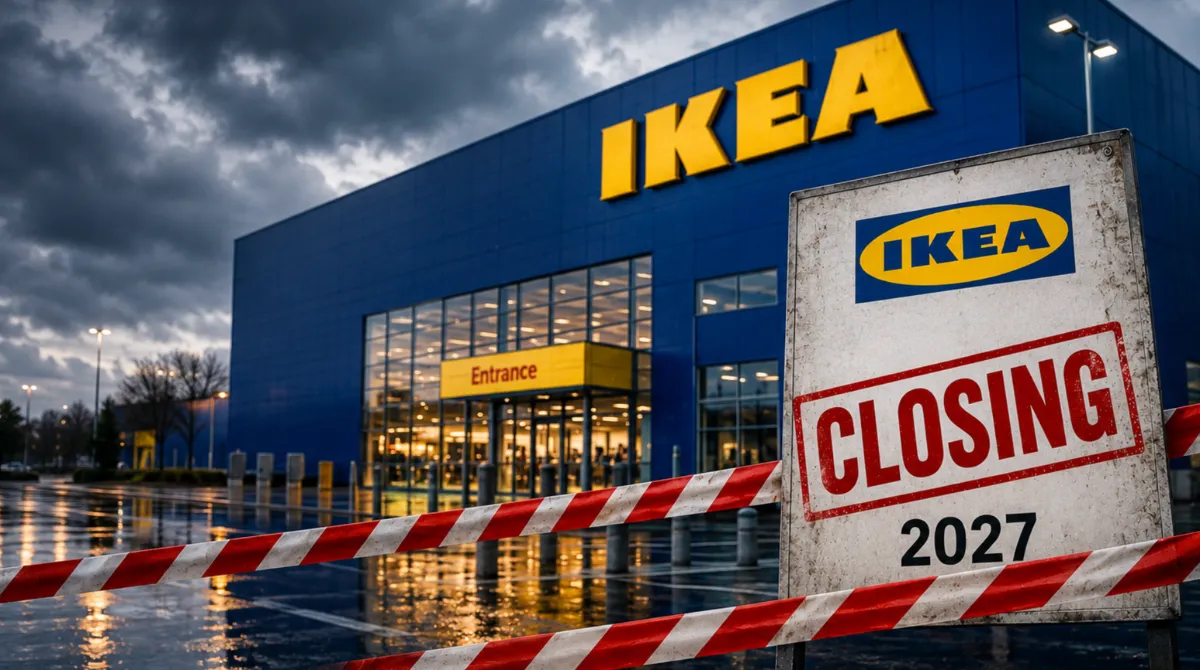
IKEA is doing something it hasn’t done in more than four decades: closing one of its iconic blue-box warehouses in its home country of Sweden. The Borlänge store closure, announced on May 6, 2026, comes on top of the company’s first-ever permanent U.S. closure in Memphis weeks earlier, and a March 2026 announcement of 945 global job cuts.
Key points:
- Borlänge closure: first IKEA store closure in Sweden in over 40 years.
- 230 employees: at risk in Borlänge, with no clarity on retained positions.
- 32,000 → 5,000 sqm: the new smaller-format store will be 84% smaller.
- 945 global layoffs: announced by Ingka Group in March 2026.
- 625 jobs cut in Sweden: concentrated in Malmö and Helsingborg offices.
- Memphis closure: 114 U.S. employees losing jobs by August 2026.
- E-commerce share: over 20% of IKEA total sales (and growing).
- New format “Lada”: smaller stores already tested in UK, Texas, Poland, with China, India, France next.
For workers across the retail sector globally, this is more than a Nordic story. As we’ve covered in our analysis of the 8 industries with the most layoffs in 2026, retail is now firmly in the same category as tech and finance, sectors being structurally transformed by digital channels and operational restructuring. The IKEA case is particularly significant because it marks the moment when even the most successful physical retail brand in Europe began retreating from its own model.
The Borlänge Closure: A Historic Moment for Swedish Retail
What Happened in Borlänge
On May 6, 2026, IKEA Sweden confirmed that its store in Borlänge, in the Dalarna region of central Sweden, will close in 2027. The store opened in 2013 after years of local negotiations, occupying a 32,000 square meter footprint that was typical of IKEA’s traditional “blue box” warehouse format. In its place, the company will open a 5,000 square meter store inside the Kupolen shopping centre nearby — a reduction of approximately 84% in floor space.
The decision is unprecedented. According to Dagens Industri, cited by Swedish public broadcaster SVT, it is the first time in more than 40 years that IKEA has closed a store in Sweden. Borlänge isn’t just any market — it’s part of IKEA’s home territory, where the brand has been deeply woven into the retail landscape since the 1960s.
The 230 employees at the Borlänge store now face uncertainty. While the current store will remain open until 2027 and the new smaller location will offer some jobs, the company has been clear that the new format requires significantly fewer staff. Michael Parker, Acting Country Manager for IKEA Sweden, told Dagens Industri:
We wanted to communicate the changes as early as possible, which means we don’t have all the answers yet. But we know that when we make changes, it also means changes for people.
For workers, the long transition period is double-edged: it gives time for negotiation with unions, but it also extends the psychological burden of uncertainty over almost two years.
The Union Perspective: “Many Are Very Worried”
The Handels trade union, which represents Swedish retail workers, has expressed deep concern about the impact on staff. Miguel Fernandez Johnson, chairman of Handels at the Borlänge workplace, told Swedish newspaper Arbetet:
When I received the information, I thought of my colleagues. Many will be affected when we move from 32,000 to 5,000 square meters. Many who have taken out loans for housing, bought a new car or started a family are very worried.
The concern reflects the broader reality of Nordic labor markets: while Sweden has stronger worker protections than the United States, large-scale retail restructuring still creates significant individual hardship.
Municipal Criticism: “We Were Informed Too Late”
The political response in Borlänge has been pointed. Erik Nises, the Social Democratic chair of the municipal executive board, told SVT that the municipality was informed only shortly before the public announcement, despite having invested significant resources in enabling IKEA’s establishment in the Norra Backa area when the store opened in 2013.
Nises said the local authority would review its existing agreements with IKEA. His criticism extends beyond the business decision itself to the way it was communicated, in a city where IKEA has been a major employer and commercial anchor for over a decade. The episode highlights a recurring tension in retail-anchored local economies: when a major employer changes format, municipalities are left with property, infrastructure, and workforce challenges that they didn’t create.
IKEA Layoffs 2026: The Bigger Picture Beyond Borlänge
The 945 Global Cuts Announced in March 2026
The Borlänge closure didn’t happen in isolation. In March 2026, parent company Ingka Group — which operates the majority of IKEA’s retail stores — announced a global restructuring affecting 945 jobs worldwide, with 625 of them in Sweden. The Local Sweden reported that the decision was made by new Ingka Group CEO Juvencio Maeztu as part of an effort to cut bureaucracy and redirect resources toward customer-facing operations.
The Swedish cuts were concentrated in two cities:
- Malmö: the location of Ingka Group’s headquarters at Hubhult, where over 1,000 employees work
- Helsingborg: where 480 of the Swedish cuts were concentrated, affecting IKEA’s global operations
Press chief Fredrik Norrlid told Aftonbladet that the company was “streamlining” — corporate language that workers in the tech sector will recognize as the standard framing for restructuring designed to reduce middle management. The pattern mirrors what we’ve seen across the tech industry, including the dynamics covered in our analysis of why Amazon is cutting 30,000 corporate jobs in 2026, where the stated rationale is also “cutting bureaucracy” and “creating ownership.”
Memphis: The First Permanent U.S. Store Closure
While Borlänge marks the first Swedish closure in 40 years, IKEA Memphis became the company’s first permanent U.S. store closure in March 2026. The Cordova, Tennessee location — the only IKEA in the Mid-South region — officially closed on May 3, 2026, with all 114 employee separations expected to complete by the end of August.
According to the WARN Notice filed with the Tennessee Department of Labor, the first round of separations began on May 9. The Greater Memphis Workforce Development Board’s rapid response team, coordinated by the Memphis Chamber, has been tasked with helping displaced workers find new positions. A company spokesperson stated that “employees will be offered positions at other locations” — a promise that is geographically meaningful only for those willing to relocate, given that the next-nearest IKEA stores are hundreds of miles away.
IKEA framed the Memphis closure as “part of a strategic shift to build a more affordable, accessible, and sustainable future.” Translated from corporate-speak, it means: this store wasn’t generating enough revenue per square foot to justify the real estate footprint.
Historical Context: How IKEA’s Layoff Strategy Has Evolved
To understand the 2026 IKEA layoffs, it helps to look at the company’s trajectory over the past decade:
- 2018: Voluntary redundancy offered to 230 Swedish employees; 110 jobs targeted
- 2018-2019: Helsingborg office moved to Malmö, affecting 180 employees
- 2022: 10,000 layoffs in Russia following Ukraine invasion and store closures (out of 12,000 retail employees)
- March 2026: 945 global cuts announced (625 in Sweden)
- March-May 2026: 114 U.S. layoffs at Memphis closure
- May 2026: 230 jobs at risk in Borlänge with 2027 transition
Each wave has had its own justification — Russia geopolitics, “streamlining,” “strategic shift.” But the underlying pattern is consistent: a structural shift from large warehouse stores to smaller formats, supported by e-commerce, with fewer workers per location and fewer locations overall.
Why IKEA Is Shrinking: The Three Forces Reshaping Retail
Force #1: E-commerce Now Exceeds 20% of Sales
The first force is the most obvious: e-commerce. IKEA Sweden reports that more than 20% of its sales now come from online channels, and many customers begin their purchase journey digitally before visiting a store or arranging delivery. For a retailer historically associated with cavernous warehouses, full-room displays, and self-service furniture collection, this shift fundamentally changes the math.
A 32,000 square meter store needs hundreds of staff: warehouse logistics, checkout, restaurant, customer service, parking attendants, inventory management. A 5,000 square meter showroom — where customers browse and order, but products are shipped directly from regional fulfillment centers — needs a fraction of that headcount. The Borlänge transition isn’t about a 20% reduction; structurally, it’s about replacing a workforce model designed for the 1980s with one designed for the 2030s.
Force #2: Competition from Amazon and Marketplaces
The second force is the rise of horizontal competitors that didn’t exist when IKEA was building its blue-box empire. Amazon now offers same-day delivery on furniture in many European markets. Wayfair, Maisons du Monde, and direct-to-consumer brands have fragmented the market in ways the IKEA model wasn’t designed to handle. Even non-furniture retailers and marketplaces now carry home goods, letting customers consolidate purchases across categories.
The result is intense price pressure. As Italian financial outlet Money.it noted in its coverage of the closure, customers increasingly prioritize “low cost and immediate availability” — two factors where IKEA’s warehouse model, requiring travel to out-of-town locations and self-assembly, struggles against same-day Amazon delivery. The pressure is similar to what we’ve documented in our analysis of craft brewery bankruptcies driven by remote work changes: when consumer behavior shifts, anchor retailers built around old assumptions lose their footing.
Force #3: Cost Base Restructuring Under New Leadership
The third force is internal. The 945-job cut announcement came under new Ingka Group CEO Juvencio Maeztu, who took over with an explicit mandate to “cut bureaucracy” and redirect resources from headquarters to customer-facing operations. This is the same playbook being executed across global corporate giants — Amazon’s Andy Jassy framed his 30,000 layoffs as creating the “world’s largest startup”; Meta’s Zuckerberg has cut layers of middle management; Microsoft and Google have done the same.
For Maeztu, the math is straightforward: IKEA’s global headquarters in Malmö and Helsingborg house thousands of corporate roles that don’t directly touch customers. In a margin-pressured environment, those roles are the first to be examined. The savings then get redirected to digital infrastructure, logistics automation, and the smaller-store format rollout.
The “Lada” Format: What IKEA’s Future Stores Will Look Like
What Is the Lada Format?
The new IKEA format that’s replacing the big-box stores is internally called “Lada” — Swedish for “barn.” It’s been piloted over the past year in select markets:
- United Kingdom: first pilot stores opened in 2025
- Texas, USA: pilot rolled out shortly after the UK
- Poland: third pilot market
- China, India, France: scheduled for 2026-2027 rollout
The Lada concept involves dramatically smaller footprints (typically 3,000-7,000 sqm vs. the traditional 25,000-35,000 sqm), located in or near urban centers rather than at city outskirts, and focused on showroom display rather than warehouse self-service. Customers can still see and touch products, but most purchases ship from regional fulfillment centers.
In Italy, IKEA has been running its own variant of this concept since 2023 with the XS store in Fiumicino — the seventh small-format store globally. The fact that the concept has now arrived in Sweden itself signals that the model is no longer experimental: it’s the new standard.
Workforce Implications: A Different Kind of Job
For workers, the Lada format means several structural changes:
- Fewer warehouse and logistics roles: products no longer self-collected by customers
- More design consultation roles: emphasis shifts to in-store advice and digital order facilitation
- Less restaurant/food court staff: smaller stores often don’t include full restaurants
- Higher digital fluency requirements: staff must support both physical and digital purchase journeys
This isn’t unique to IKEA. It’s the same workforce transition happening across retail. Workers concerned about their own retail careers may benefit from our analysis of jobs that are disappearing fastest in 2026 and our guide to the fastest-growing jobs of 2026, which identify the skills and roles best positioned for the next decade.
FAQ about the IKEA Layoffs of 2026
Why is IKEA closing stores in 2026?
IKEA is closing select stores in 2026 because of three structural forces: (1) e-commerce now exceeds 20% of total sales, reducing the need for large warehouse footprints; (2) intensifying competition from Amazon, Wayfair, and marketplace retailers offering same-day delivery; (3) a corporate restructuring under new Ingka Group CEO Juvencio Maeztu aimed at cutting bureaucracy and redirecting resources to digital and smaller-format stores. The Borlänge closure is the first in Sweden in 40 years, but it follows a global pattern of large-store closures and smaller “Lada” format openings.
How many IKEA layoffs are happening in 2026?
IKEA announced 945 global layoffs in March 2026, with 625 of them in Sweden (concentrated in Malmö and Helsingborg offices). Additionally, the Memphis, Tennessee store closure will affect 114 U.S. employees through August 2026, and the Borlänge, Sweden closure puts 230 jobs at risk through 2027. The total direct headcount impact for 2026 is approximately 1,289 employees, though the company has stated some workers may be transferred to other locations or absorbed into the new smaller-format stores.
Will IKEA close more stores in Sweden?
According to Michael Parker, Acting Country Manager for IKEA Sweden, the Borlänge decision “is not the start of a wider wave of closures in Sweden” and there are “no plans to close additional warehouses.” However, this statement should be read alongside the global pattern: IKEA is systematically transitioning from large warehouse stores to smaller Lada-format showrooms in every major market. The pace and exact locations may vary, but the structural direction is clear. Workers and municipalities in Swedish cities with aging IKEA stores have reason to monitor this trend closely.
What is IKEA’s new Lada format?
“Lada” (Swedish for “barn”) is IKEA’s small-format store concept, piloted since 2025 in the UK, Texas, and Poland, with China, India, and France next. Lada stores typically measure 3,000-7,000 square meters (vs. 25,000-35,000 for traditional blue-box stores), are located in or near urban centers, and focus on showroom display rather than self-service warehouse pickup. Italy’s XS store format in Fiumicino, opened in 2023, follows the same logic. The Borlänge replacement store will operate as a 5,000 sqm Lada-style location inside the existing Kupolen shopping centre.
What happens to the 230 employees in Borlänge?
The 230 Borlänge employees face a long but uncertain transition. The current store will remain open until 2027, when the smaller 5,000 sqm replacement opens at Kupolen shopping centre. IKEA has acknowledged that the smaller format needs fewer staff but has not specified the final headcount. Standard Swedish labor practice requires negotiations with the Handels trade union, which represents most workers. Some employees may be transferred to the new store, offered positions at other Swedish IKEA locations, or take negotiated severance. The long timeline gives workers time to plan but also extends the psychological burden of uncertainty.
This pattern — the automation and digital-channel-driven contraction of historically stable workforces — is the defining labor market story of the late 2020s. It’s the same dynamic visible in the April 2026 jobs report, where growth concentrated almost exclusively in healthcare while every other major sector contracted. It’s visible in tech layoffs, in finance restructuring, and now, definitively, in legacy retail.
As Miguel Fernandez Johnson of the Handels union put it when speaking to Arbetet about his Borlänge colleagues: many “have taken out loans for housing, bought a new car or started a family” — and they are now reckoning with the fact that the economic foundation those decisions were built on has shifted underneath them.