Key points
- Your 401(k) stays yours after a layoff. Your own contributions are always 100% vested.
- You have four options: leave it, roll it into a new employer’s plan, roll it into an IRA, or cash it out.
- Cashing out usually means income tax plus a 10% extra tax, unless you left the job in or after the year you turn 55.
- Use a direct rollover: if the check is made out to you, the plan withholds 20% and you have 60 days to redeposit the full amount.
- A big layoff can trigger a partial plan termination, which makes your employer’s contributions fully vested.
Losing your job does not mean losing your retirement savings. But the choices you make in the weeks after a layoff can cost you thousands of dollars in taxes. Here is what happens to your 401(k), based on the IRS rules.
What are your options for a 401(k) after a layoff?
According to the IRS: termination of employment, you generally have four options:
- Leave the money in your old plan. Useful if the plan has good investments and low fees. If your balance is small (the IRS page cites less than $5,000), your employer may require you to move it.
- Roll it into your new employer’s plan, if the new plan accepts rollovers.
- Roll it into an IRA. A traditional IRA keeps the money tax-deferred. A Roth IRA is possible, but you pay income tax on the untaxed amount the year you convert.
- Cash it out. You get the money now, but you pay income tax and possibly a 10% extra tax.
How much does cashing out really cost?
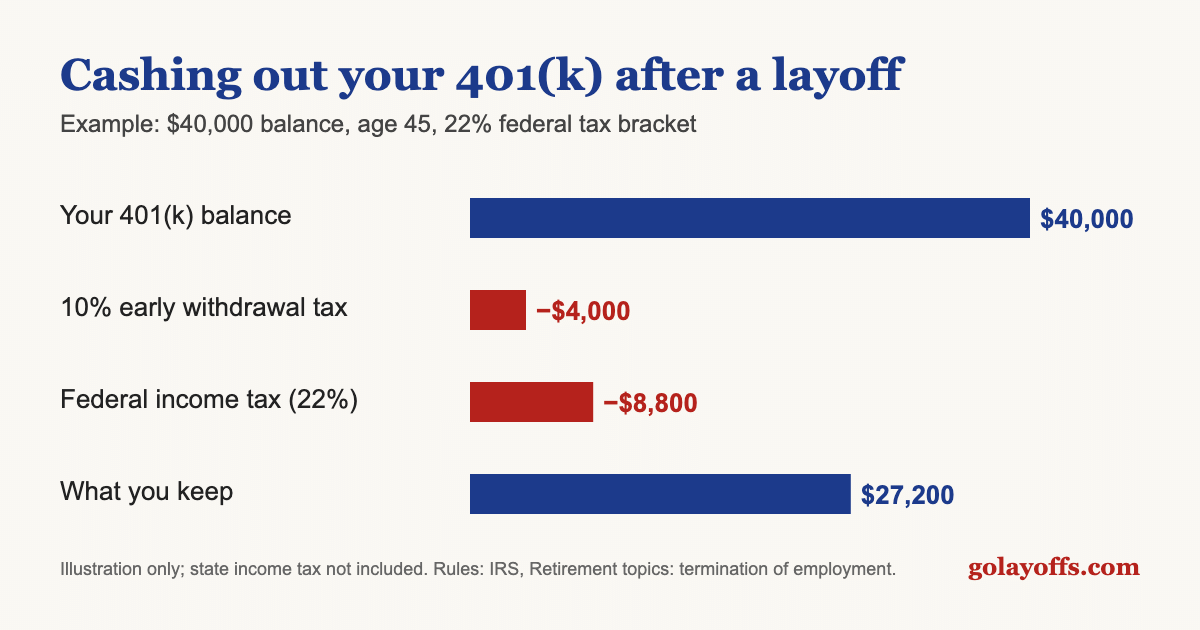
A cash-out is taxed as income, and if you are under the age threshold you also owe the 10% additional tax. Try your own numbers:
What would a cash-out cost you?
10% early withdrawal tax
Federal income tax
What you keep
Simplified illustration: the whole withdrawal is taxed at the bracket you pick, and state income tax is not included. The plan withholds 20% up front; the final tax is settled on your return.
Can you avoid the 10% penalty?
Yes, in some cases. The IRS: exceptions to the early distribution tax include separation from service during or after the year you turn 55 (50 for some public safety employees). This applies to the plan of the employer you left, not to IRAs. If you roll the money into an IRA first, the age-55 exception no longer applies to it.
Direct rollover or 60-day rollover?
Ask the old plan to send the money directly to the new plan or IRA. If the plan pays you instead, it usually withholds 20% for federal taxes. To avoid tax, you must deposit the full amount, including the 20% that was withheld, within 60 days. Any part you do not redeposit counts as income and may also owe the 10% tax.
What happens to your 401(k) loan?
If you had a loan from your 401(k), many plans subtract the unpaid balance from your account when you leave (a “plan loan offset”). According to the IRS: plan loan FAQs, when the offset is due to a severance from employment, you have until your tax return due date, including extensions, to roll over that amount and avoid tax.
Vesting: can a layoff make you fully vested?
Your own contributions are always 100% vested. Employer contributions follow the plan’s schedule. But when a layoff affects many participants, it can count as a partial plan termination: the IRS: partial termination of plan explains that a turnover rate of 20% or more creates a presumption of partial termination, and affected employees must become fully vested. If your company cut a large part of its staff, ask HR or the plan administrator about it. See which companies are cutting in our Tech Layoff Tracker and layoffs today.
A checklist for the first 60 days
- Download your latest 401(k) statement and check your vested balance.
- Ask the plan about loans, vesting and whether a partial termination applies.
- Choose a direct rollover if you are moving the money.
- Before cashing out, compare it with your health insurance options and your severance.
FAQ
Do I lose my 401(k) if I get laid off?
No. The money in your 401(k) stays yours. Your own contributions are always 100% vested; employer contributions follow the plan’s vesting schedule, unless a partial plan termination makes them fully vested.
Can I withdraw my 401(k) after a layoff without penalty?
Only in some cases. If you left your job in or after the year you turn 55, the 10% early distribution tax does not apply to that employer’s plan. You still pay income tax on the untaxed amount.
How long do I have to roll over my 401(k) after a layoff?
There is no deadline to move it while it stays in the plan. If you take a distribution, you have 60 days to deposit it into an IRA or new plan. For a plan loan offset after leaving a job, you have until your tax return due date, including extensions.
What happens to my 401(k) loan if I get laid off?
Many plans offset the unpaid loan from your balance when you leave. The offset counts as a distribution, but you can avoid tax by rolling over the same amount by your tax filing deadline, including extensions.
Sources: IRS: termination of employment, IRS: exceptions to the early distribution tax, IRS: partial termination of plan, IRS: plan loan FAQs. This article explains general federal rules and is not tax advice. Updated October 16, 2026. See something wrong? Tell us.