
How much warning does an employer have to give before a layoff? It depends on the size of the employer, how many people lose their jobs and, above all, on the state. The federal WARN Act sets a 60-day minimum for large layoffs, and several states add their own rules, some with longer notice and one with mandatory severance. This guide compares the federal law with the state laws in California, New York, New Jersey, Washington, Illinois and Maryland, using each official source.
- Federal minimum: 60 calendar days for plant closings and mass layoffs at employers with 100 or more employees.
- Longest notice: 90 days in New York and New Jersey.
- Smaller employers covered: 75 or more employees in California and Illinois, 50 or more full-time employees in New York.
- Mandatory severance: New Jersey requires 1 week of pay per full year of service in covered layoffs.
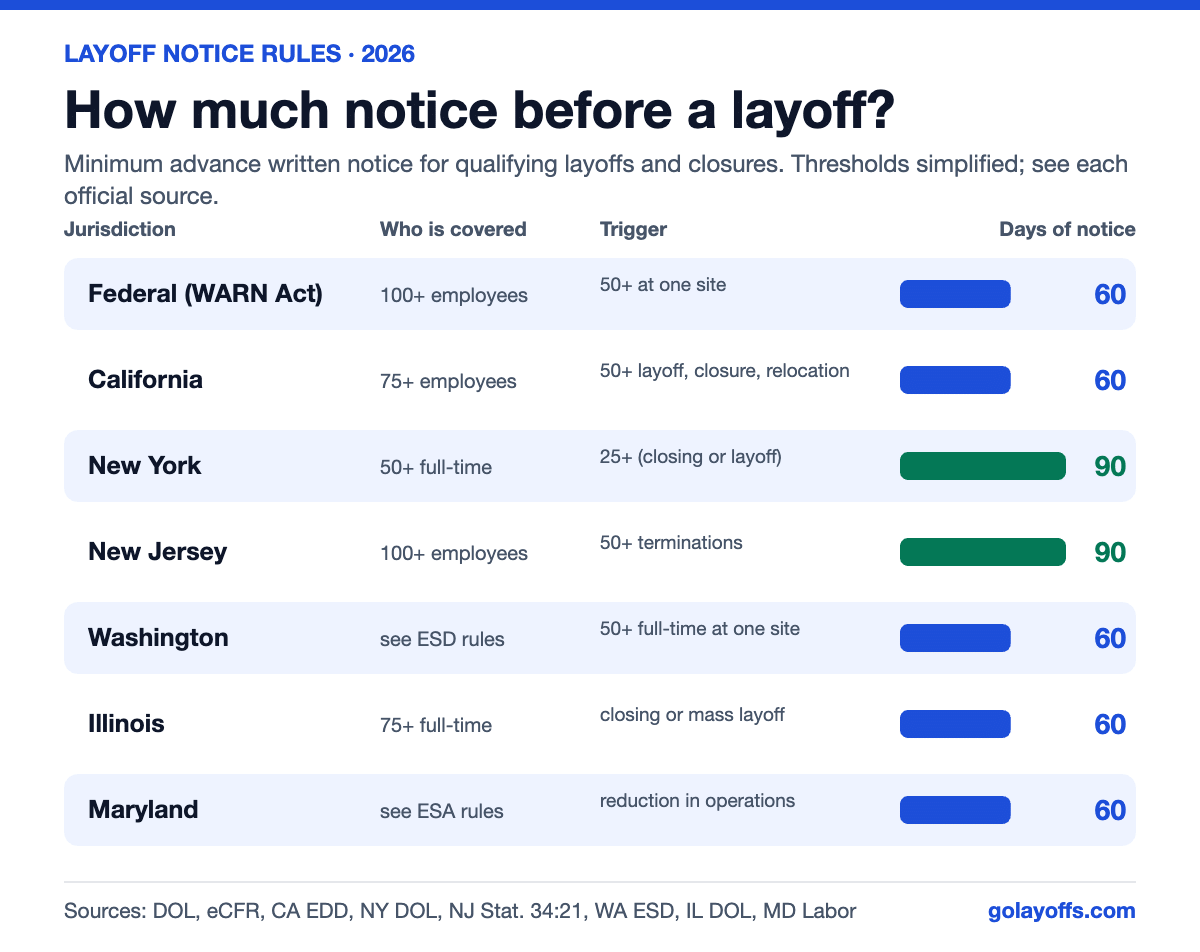
Layoff notice laws compared
| Jurisdiction | Who is covered | What triggers notice | Notice | Other rules |
|---|---|---|---|---|
| Federal (WARN Act) | Employers with 100 or more employees (generally not counting recent or part-time workers) | Plant closing or mass layoff affecting 50 or more employees at one site | 60 calendar days | Notice also goes to employee representatives, the local chief elected official and the state dislocated worker unit |
| California | Employers with 75 or more full-time and part-time employees | Layoff of 50 or more within 30 days, a plant or facility closure, or a relocation | 60 days | California Labor Code, Section 1400.5 |
| New York | Private employers with 50 or more full-time employees in the state | Closings affecting 25 or more employees; mass layoffs of 25 or more (if at least 33% of the site) or 250 or more; certain relocations and cuts in hours | 90 days | Employers that skip notice may owe back wages and benefits and a civil penalty |
| New Jersey | Employers with 100 or more employees | Transfer or termination of operations, or a mass layoff, ending 50 or more jobs within 30 days | 90 days (or the federal period, if longer) | Mandatory severance of 1 week of pay per full year of service, plus 4 extra weeks if notice is short |
| Washington | Employers with a qualifying closure, layoff or cut in hours | Closure or mass layoff affecting 50 or more full-time employees at one site within 30 days, or hours cut by 50% or more for 50 or more workers | 60 days | Notice to the Employment Security Department, affected employees and the local chief elected official |
| Illinois | Employers with 75 or more full-time employees | Plant closing or mass layoff | 60 days | Employers that fail to give notice owe back pay and benefits for up to 60 days |
| Maryland | Employers that meet the Economic Stabilization Act criteria | Reduction in operations | 60 days | Revised regulations took effect October 13, 2025 |
Simplified summary of the official sources linked in the first column, checked October 2026. Thresholds have exceptions; read the source for your situation.
What does the federal WARN Act require?
According to the U.S. Department of Labor, the Worker Adjustment and Retraining Notification Act requires employers with 100 or more employees (generally not counting those who have worked less than six months in the last 12 months and those who average less than 20 hours a week) to give at least 60 calendar days of advance written notice of a plant closing or mass layoff affecting 50 or more employees at a single site. Notice also goes to employees’ representatives, the local chief elected official and the state dislocated worker unit.
Under the federal regulations (20 CFR Part 639), a mass layoff that is not a plant closing must affect at least 33% of the active employees and at least 50 employees at a site within 30 days, or 500 or more employees. The law includes exceptions for unforeseeable business circumstances, faltering companies and natural disasters. For more detail, see our guide to mass layoff regulations.
California WARN Act
According to the California Employment Development Department, the state law generally applies to employers with 75 or more full-time and part-time employees that plan a layoff of 50 or more employees within 30 days, a plant or facility closure, or a relocation. Employers must give written notice at least 60 days in advance (California Labor Code, Section 1400.5). See every recent notice on our California WARN notices page.
New York WARN Act
The New York State Department of Labor says the state WARN Act applies to private businesses with 50 or more full-time employees in New York. It covers closings affecting 25 or more employees, mass layoffs of 25 or more full-time employees when they make up at least 33% of the site, mass layoffs of 250 or more full-time employees, and certain relocations and reductions in hours. Covered businesses must give 90 days of notice, and those that do not may have to pay back wages and benefits and a civil penalty.
New Jersey WARN Act and mandatory severance
New Jersey’s law, amended in 2023 (N.J. Stat. 34:21), applies when a transfer or termination of operations, or a mass layoff, ends the employment of 50 or more employees within 30 days. Employers with 100 or more employees must give at least 90 days of notice, or the federal period if that is longer. Each terminated employee must receive severance equal to one week of pay for each full year of employment, and an extra four weeks of pay if the employer gave less notice than required. The New Jersey Department of Labor receives the notices.
Washington State WARN law
Washington’s version of the law is called Mass Layoffs and Business Closings. According to the Employment Security Department, it applies to a closure affecting 50 or more full-time employees at a single worksite, a mass layoff of 50 or more full-time workers within 30 days at a single site (including temporary layoffs), and cuts in hours of 50% or more for 50 or more workers in each month of a 6-month period. Employers must give written notice 60 days before the layoff to the ESD, the affected employees and the local chief elected official. Our Washington WARN notices page lists the latest filings.
Illinois WARN Act
According to the Illinois Department of Labor, the Illinois WARN Act requires employers with 75 or more full-time employees to give workers and state and local government officials 60 days of advance notice of a plant closing or mass layoff. An employer that fails to do so is liable to each affected employee for back pay and benefits for the period of the violation, up to 60 days.
Maryland Economic Stabilization Act
The Maryland Department of Labor says the Economic Stabilization Act requires employers to give 60 days of notice of a reduction in operations to the affected employees, the department’s Dislocation Services Unit and other parties when the law’s criteria are met. Revised regulations took effect on October 13, 2025, so check them for the current thresholds.
What if your employer did not give enough notice?
Remedies depend on the law that applies. Illinois and New York spell out back pay and benefits, and New York adds a possible civil penalty; New Jersey adds four weeks of pay to the mandatory severance. At the federal level, the Department of Labor’s Employment and Training Administration administers WARN but has no role in seeking damages for workers who did not receive adequate notice, so workers who think their rights were violated may want to talk to an employment lawyer. Before signing a separation agreement, read our guide on negotiating severance, and check how long your health insurance lasts after a layoff.
How to check whether your employer filed a WARN notice
Many states publish the WARN notices they receive. Our tracker collects California and Washington notices twice a day; for other states it links to the official source.
| State | Notices, last 30 days | Workers affected, last 30 days | Workers affected, last 90 days | Latest notice | Official source |
|---|---|---|---|---|---|
| California | 155 | 6,234 | 16,258 | Oct 7, 2026 | California Employment Development Department (EDD) |
| Washington | 37 | 13,067 | 16,827 | Oct 7, 2026 | Washington Employment Security Department (ESD) |
| New York | 14 | 824 | 4,135 | Oct 6, 2026 | New York State Department of Labor, WARN Dashboard |
| Texas | 9 | 806 | 4,092 | Oct 6, 2026 | Texas Workforce Commission (TWC) |
| New Jersey | Published only as a monthly PDF list, without daily dates: see the official source | New Jersey Department of Labor, WARN notices (monthly PDF) | |||
Counts are based on the date each state received or processed the notice. A WARN notice covers a planned layoff or closure at one site, so the numbers show announced job cuts, not all layoffs. Last checked: October 8, 2026, 11:06 pm EDT. Updated twice a day from official state sources.
Recent example: in October 2026 HubSpot announced it would cut nearly 660 jobs; check the state pages above for notices tied to large layoffs like this one.
Layoff Notice FAQ
How much notice does an employer have to give before a layoff?
Under the federal WARN Act, covered employers must give at least 60 calendar days of written notice before a plant closing or mass layoff. New York and New Jersey require 90 days for covered layoffs, and states such as California, Washington, Illinois and Maryland have their own 60-day rules.
Which employers are covered by the WARN Act?
The federal law generally covers employers with 100 or more employees, not counting workers employed less than six months in the last 12 months or averaging under 20 hours a week. Some state laws apply to smaller employers, for example 75 or more employees in California and Illinois and 50 or more full-time employees in New York.
Does any state require severance pay in a layoff?
Federal law does not require severance. New Jersey requires covered employers to pay one week of severance per full year of service in a mass layoff or closing, plus four additional weeks if the employer gives less notice than required.
What happens if my employer did not give notice?
Remedies depend on the law that applies. Illinois says employers that fail to give notice are liable for back pay and benefits for up to 60 days, and New York says employers may owe back wages, benefits and a civil penalty. The U.S. Department of Labor does not seek damages for workers under the federal WARN Act, so consider speaking with an employment lawyer.
Where can I check whether my employer filed a WARN notice?
Many states publish the notices they receive. Our WARN notices tracker collects California and Washington notices twice a day and links to the official pages of other states.
Related Reading
- WARN notices tracker by state
- Mass layoffs and the WARN Act explained
- US layoffs statistics
- Can you be laid off while on medical leave?
- How to negotiate severance
Sources
- U.S. Department of Labor, Plant Closings and Layoffs
- 20 CFR Part 639, WARN regulations (eCFR)
- California EDD, WARN
- New York State Department of Labor, WARN
- New Jersey WARN Act, N.J. Stat. 34:21 (2023 law text)
- Washington ESD, WARN requirements
- Illinois Department of Labor, WARN Act
- Maryland Department of Labor, WARN and Economic Stabilization Act
This guide is general information, not legal advice. Laws change and have exceptions; check the official source for your state or speak with an employment lawyer.