Key points
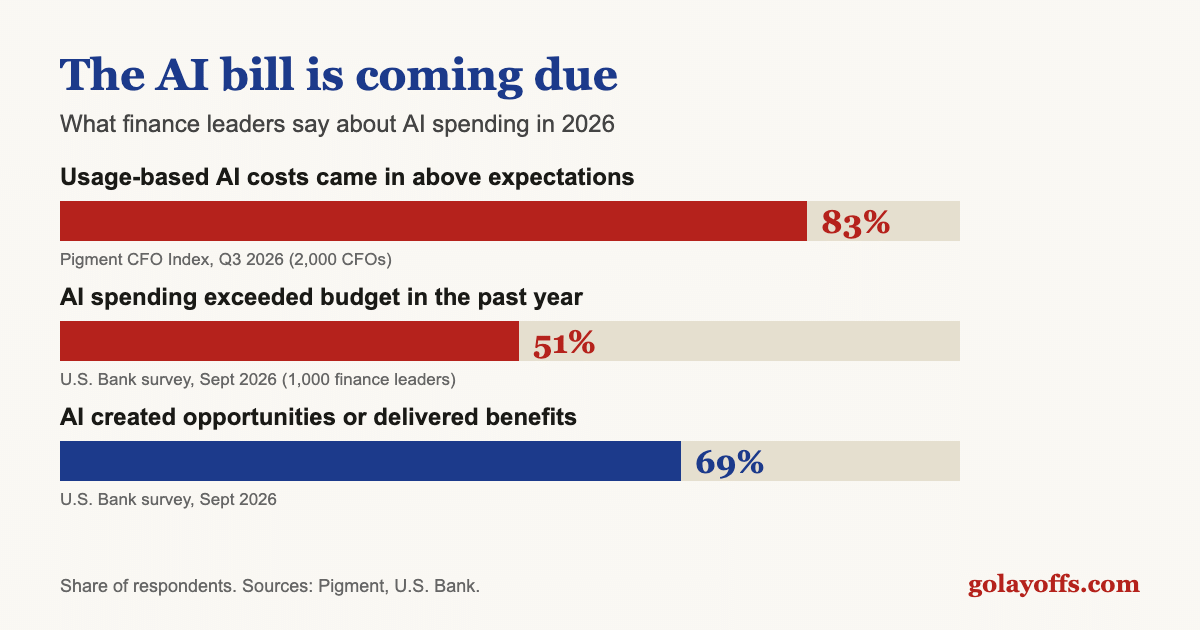
- 83% of CFOs say usage-based AI costs came in above expectations (Pigment, 2,000 finance executives).
- 51% of US finance leaders overspent their AI budget in the past year, but 69% say AI paid off in some way (U.S. Bank).
- Uber used up its 2026 AI coding budget in four months; its COO says the spending is getting “harder to justify”.
- Microsoft began pulling Claude Code licenses in one division and moved engineers to its own Copilot CLI.
- Layoffs that cite AI peaked in May and have slowed since, in our tracker and in Challenger’s data.
For two years, companies raced to spend on artificial intelligence, and many cut jobs while doing it. Now the bills are arriving. New surveys of finance chiefs show AI costs running above budget, and some of the biggest tech companies are putting limits on how much their own employees can use. Here is what the data says, and what it means for workers.
The AI bill is coming due
Share of finance leaders, 2026 surveys. Hover or tap a bar.
Usage-based AI costs came in above expectations
Pigment CFO Index, Q3 2026
AI spending exceeded budget in the past year
U.S. Bank, September 2026
AI created opportunities or delivered benefits
U.S. Bank, September 2026
Plan to reduce headcount to manage inflation
U.S. Bank, September 2026
Hover or tap a bar to see the details.
Why are companies cutting back on AI spending?
Because many AI tools charge by use. The Pigment CFO Index, based on 2,000 CFOs and finance executives surveyed between August 19 and September 21, found that 83% of organizations say consumption-based AI costs came in above expectations. A U.S. Bank survey of 1,000 US senior finance leaders, released September 29, found that 51% spent more than budgeted on AI tools in the past year. The same survey shows why companies are not walking away: 69% say AI investment created opportunities or delivered benefits.
Which companies are reining in AI costs?
- Uber used up its entire 2026 budget for AI coding tools in about four months, after an internal leaderboard ranked teams by usage, according to Fortune. President and COO Andrew Macdonald said that if the company can’t connect AI use to features it ships, “that trade becomes harder to justify.” See Uber layoffs.
- Microsoft began canceling most Claude Code licenses in its Experiences + Devices division and moved engineers to its own GitHub Copilot CLI, according to Windows Central, citing The Verge. Microsoft described the move as strategic. See Microsoft layoffs.
AI spending and layoffs: what changed in 2026
Earlier this year, AI was the most common reason companies gave for job cuts. Challenger, Gray & Christmas counted 120,136 announced cuts that cited AI from January to September, about 21% of all cuts. A Reuters factbox lists dozens of employers, from Amazon to Kroger, that tied job cuts over the past year to AI or to shifting investment toward it. But the trend has slowed: in September, only 3,961 cuts cited AI, about 9% of the month’s total. Our own tracker shows the same shape.
Tech layoffs that cite AI, by month
Announcements in our tracker, 2026. Red: the company itself linked the cut to AI.
May 2026: 6 of 11 announcements cited AI
For the full picture, read AI layoffs in 2026: how many are really caused by AI? and browse every cut in the Tech Layoff Tracker.
Is the AI bubble bursting?
The surveys point to cost discipline, not a collapse. Most finance leaders still report benefits, and AI budgets are being centralized and capped rather than canceled. What is changing is the question companies ask: not “how much AI are we using?” but “what are we getting for it?” That shift matters for workers, because AI was often the reason given for cutting jobs. In the U.S. Bank survey, reducing headcount ranked last among nine ways finance leaders plan to manage inflation, at 28%.
What it means for your job
- If your company cut staff “because of AI”, the savings are now under the same scrutiny as the AI bills.
- Roles that show measurable results with AI tools are in a stronger position than roles that only use them.
- Track new cuts in your industry on Layoffs today and the company directory, and read Will AI replace all jobs?
FAQ
Are companies cutting AI spending in 2026?
Many are capping it rather than cutting it. 51% of US finance leaders say AI spending exceeded budget in the past year (U.S. Bank), and 83% of CFOs say usage-based AI costs came in above expectations (Pigment). Uber and Microsoft have both reined in spending on AI coding tools.
Why are AI costs higher than expected?
Many AI tools charge by usage (tokens), so costs grow with every request. When companies push employees to use AI heavily, the bill can grow faster than budgets planned for.
Will cutting AI spending mean fewer layoffs?
It is too early to say. Layoffs that cite AI peaked in May 2026 and slowed afterwards, according to our tracker and Challenger, Gray & Christmas. In the U.S. Bank survey, reducing headcount ranked last among nine ways finance leaders plan to manage inflation.
Is the AI bubble bursting?
The data shows cost discipline, not a collapse: most finance leaders still report benefits from AI, and many plan to keep investing. What is changing is that companies now want to see results for the money they spend.
Sources: Pigment CFO Index (as reported by TechNode); U.S. Bank survey (as reported by Accounting Today); Fortune; Windows Central; Challenger, Gray & Christmas; Reuters; GoLayoffs Tech Layoff Tracker. Updated October 18, 2026. See something wrong? Tell us.